Can you refuse a CID interview without making the situation worse? If you are suspected of an offense, you can decline substantive questions by clearly invoking your right to remain silent and asking to speak with a lawyer. That answer changes for a witness who isn't suspected and for someone who has already answered a few questions, and once charges are preferred, questioning must stop when you request counsel.
The part many guides skip is the gap between refusing CID and ignoring every inquiry. A clear invocation is narrow: it protects the choice not to answer incriminating questions, while a blanket refusal can spill into conduct the right does not cover.
Two pressure points decide most encounters: what to say when the agent insists you are only a witness, and how to treat answers already given before the tone shifted. Earlier words do not rewind, but a calm, explicit request for counsel can still mark where the questioning stops.
Table of Contents
- Can You Refuse a CID Interview as a Service Member?
- What to Do Next If CID Contacts You
- Is Refusing CID Different From Ignoring Every Inquiry?
- What Happens If You Already Answered Some Questions?
- Mistakes That Can Make Your Situation Worse
- Where to Get Free or Civilian Military Defense Help
- Frequently Asked Questions About CID Interviews
Can You Refuse a CID Interview as a Service Member?
The right comes from Article 31(a) of the Uniform Code of Military Justice, codified at 10 U.S.C. § 831(a), which prohibits compelling a person subject to the UCMJ to incriminate themselves or to answer questions that may tend to incriminate them, as the Army Command Handbook explains.
Article 31 reaches further than a civilian Miranda warning. Miranda attaches to custodial police interrogation. Article 31(b) can apply whenever one person subject to the UCMJ requests a statement from another suspected service member, whether the questioner is a CID special agent, a commander, or a noncommissioned officer acting in a disciplinary role. Before questioning, that person must explain the suspected offense, advise that the member doesn't have to make a statement, and warn that anything said may be used as evidence.
The warning doesn't open the door to questions. Military legal guidance in the same handbook states that a suspect isn't required to provide information about the alleged offense, and that statements may be used in an Article 15 proceeding or at a court-martial. The practical response is to say plainly, "I am invoking my right to remain silent. I want to speak with a lawyer."
How the answer changes by status
| Your situation | Can you decline questions? | What the rules say to do |
|---|---|---|
| Suspected of the offense under investigation | Yes, for substantive questions about that offense | Clearly invoke your right to remain silent and request a lawyer |
| Witness, not suspected | Sometimes; a legal advisor decides whether an order to answer is permissible | Identify the self-incrimination concern and get advice before answering anything substantive |
| Already answered some questions | Yes, questioning must stop from that point | Say clearly that you are invoking silence and want counsel |
| Charges already preferred | Yes, questioning must stop when you request counsel | A later waiver on the same offenses is invalid unless the prosecution proves you started the contact |
Read that table as a starting point, not a rulebook. Rules differ by branch, by situation, and by whether the person across the table is an investigator or your commander, so a status change mid-conversation can change what protections apply.
What to Do Next If CID Contacts You
A CID agent can call, appear at your workplace, or ask the commander to set up a meeting. The response is the same in each case, and it's far easier to execute when it's a checklist rather than a decision made in a hallway.
The first five minutes
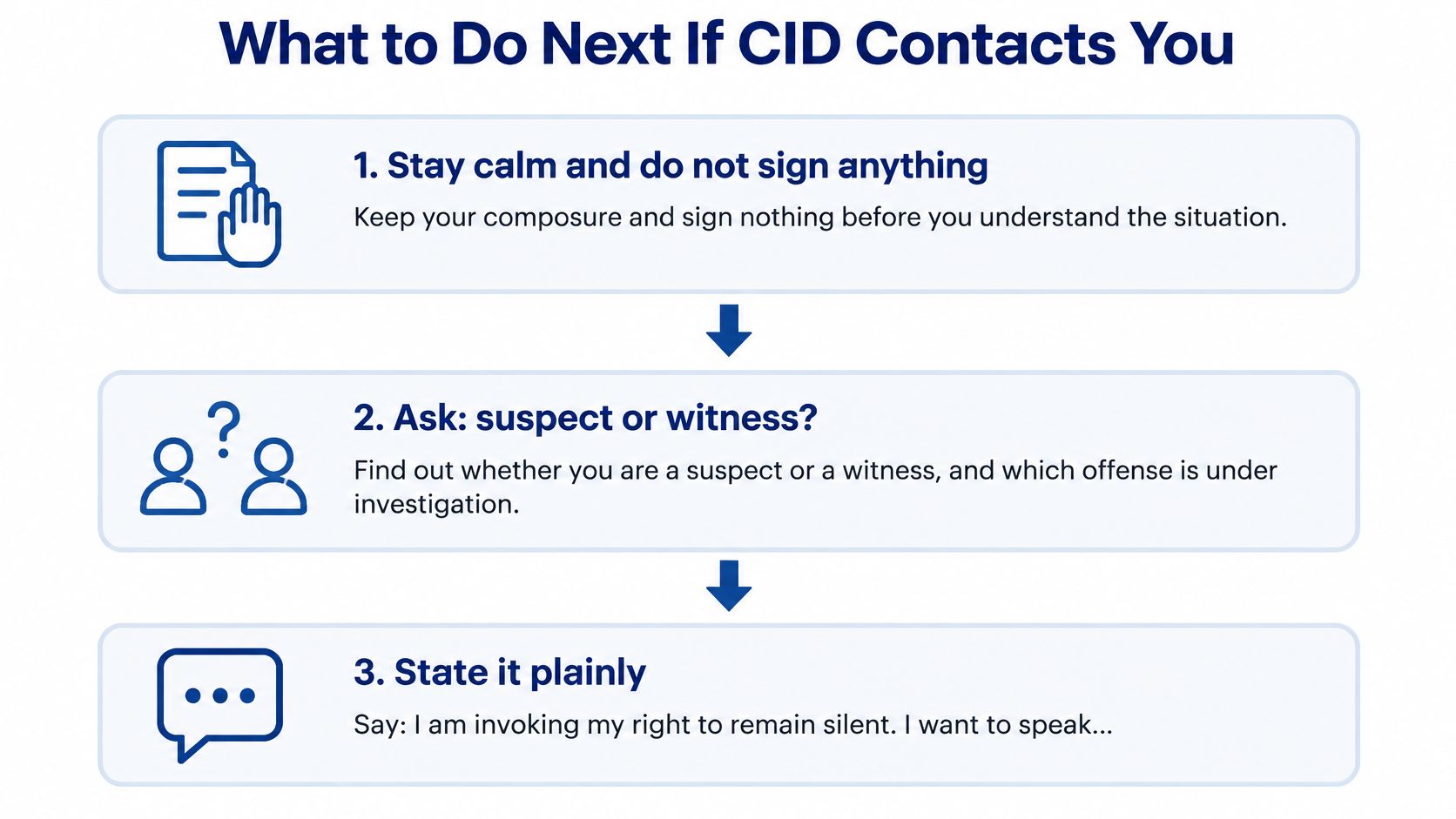
- Stay calm and sign nothing. Ask two questions before anything else: whether you are a suspect or a witness, and which offense is under investigation. Those answers tell you which rules apply.
- Say the sentence. "I am invoking my right to remain silent. I want to speak with a lawyer." Under the Military Rules of Evidence,%20dtd%2019%20Jul%202017.pdf), a statement obtained in violation of Article 31 is involuntary and generally inadmissible against the accused, subject to limited exceptions, which is why the wording and timing matter.
- Stop answering substantive questions. Don't explain, argue, or correct the facts. Corrections are statements too.
- Ask that the request be recorded and confirm the interview is ending. A clear request on the record is what makes later disputes about waiver resolvable.
If a rights warning isn't clear, ask for clarification before you respond to anything. Receiving the warning doesn't mean you've agreed to waive silence.
The next few days
- Contact base defense counsel the same day. Free defense counsel exists at every installation, and the sooner counsel hears the facts, the more of the file can still be shaped.
- Vet any civilian lawyer before paying a retainer. Check license and bar status on the state bar website first. A directory search is a shortlist, not a background check.
- Keep a private record of dates, names, what was asked, and what was said. Write it for your lawyer, not for the file.
- Don't delete anything. Destroying, altering, or hiding records or messages can turn a difficult case into a much worse one.
Why the exact words matter: "I would rather not talk" invites an argument about what you meant. "I want a lawyer, and I am not answering questions" doesn't.
Service members stationed outside the U.S. face the same rights plus host-nation questions, so defense representation for overseas installations is worth lining up before the next interview. These steps are a starting point; branch rules and local practice vary, so talk to a licensed attorney about your own situation.
Is Refusing CID Different From Ignoring Every Inquiry?
The assumption worth testing is simple. Service members hear "you can refuse CID" and convert it into "you can refuse anything anyone in uniform asks." The first is protected by Article 31. The second isn't, and blurring them can turn a clean invocation into what looks like defiance.
Army Regulation 15-6 draws that line. A person who refuses to provide information has to state specifically that the refusal rests on Article 31 or the Fifth Amendment, and a legal advisor then decides whether the person can be ordered to answer when the refusal isn't legally protected. The regulation separates suspected offenders from witnesses and notes that the privilege is personal, so it can't be used to shield someone else.
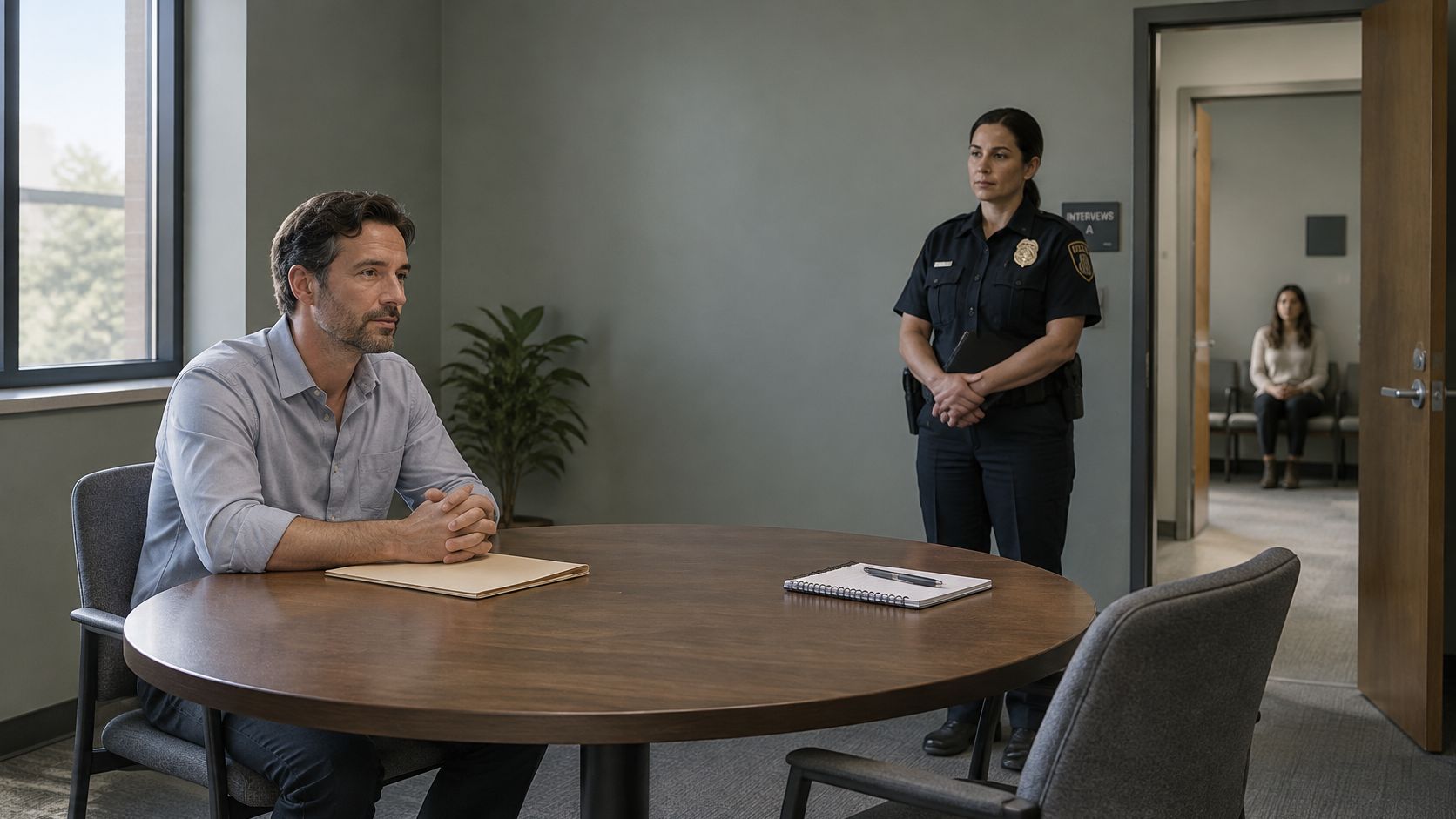
Picture the interview where an agent opens with "you're just a witness here" and then asks where you were, who you were with, and whose idea it was. Those answers can expose you to discipline even while the label says witness. Guessing about your own status in the room is a losing move. Name the concern instead: "I'm concerned my answers could incriminate me, and I want to speak with a lawyer before I answer."
The same facts often get collected twice, once in a command or administrative inquiry and once in a criminal investigation, each under its own authority. A refusal that holds in one setting doesn't settle the other, which is exactly why counsel before answering protects all of them at once.
What Happens If You Already Answered Some Questions?
An answer already given does not vanish when the interview stops. A late decision to stop still matters. Military guidance states that questioning must stop immediately when a suspect requests counsel or indicates a desire to remain silent, and any later re-interview requires a fresh rights advisement and, where applicable, counsel, according to these JAG Legal Center materials on suspect interviews.
What stopping looks like in practice
Stopping works like closing a door that is still open, not rewinding what already passed through it. The earlier answers remain part of the picture, while new questions have to wait for the protections that apply at that moment.
Two things follow. A later invocation still counts going forward, even if the first answers were voluntary. What happens to those earlier answers depends on the warnings given, any waiver, and how the questioning proceeded, which are legal questions for a lawyer rather than problems to solve alone.
Saying "I need to stop now" mid-interview keeps the earlier answers from being treated as false by itself. It marks the point where the conversation ends until counsel is present.
Silence also does not end the investigation. A command can still pursue records, witnesses, searches, and administrative processes, so refusing CID is different from ignoring every inquiry. What silence prevents is adding more admissions that investigators can build on.
Three questions to bring to a lawyer: can questioning stop now, what happens to what was already said, and what must CID do before asking again.
Mistakes That Can Make Your Situation Worse
Invoking silence protects you only if your own conduct doesn't undercut it. The pattern that sinks cases is rarely a dramatic confession. It's a service member who meant to stay quiet and then volunteered a written statement, a friendly off-the-record chat, or a small correction that grew into a version of events.
| Action | Why it can hurt | Safer response |
|---|---|---|
| Giving a written statement | Creates a record you cannot take back | Say you will not make a statement without a lawyer |
| Agreeing to an off-the-record talk | Informal answers can still be used as evidence | Decline and ask for counsel |
| Explaining facts after invoking your right | Each comment can be used later | Stop discussing the facts |
| Giving a false official statement | A false statement is a separate UCMJ offense under Article 107 | Say nothing rather than give an untrue answer |
| Interfering with the investigation | Obstructing an investigation can bring a separate charge under Article 134 | Do not hide, destroy or alter records or pressure witnesses |
One more piece of reassurance for anyone worried about how silence looks. Article 31(c) provides that no adverse inference may be drawn at court-martial from an accused's refusal to answer questions or testify, as the Army's Criminal Law Deskbook on self-incrimination sets out. Silence itself isn't evidence of guilt.
Declining to answer and giving an untrue answer are entirely different acts, and only one of them creates a new charge. When unsure, say nothing and call counsel.
Where to Get Free or Civilian Military Defense Help
Every base legal office includes defense counsel whose job is to advise and represent service members: the Army Trial Defense Service, the Air Force Area Defense Counsel, the Navy Defense Services Office, and the Marine Corps Defense Services Office. That help is free, and using it doesn't require admitting anything.
Civilian counsel is the other route, and many service members use both. The UCMJ Military Defense Lawyer Directory lists civilian firms that handle courts-martial, Article 15 matters, and separation boards, and it can be searched by state, installation, or overseas location.
Before hiring anyone, ask three questions: how much UCMJ experience the lawyer has, how they'll communicate with you during the investigation, and what they charge. Then check the lawyer's license or bar status on the state bar website. This article doesn't rank or recommend any lawyer, and the right choice depends on the case and the branch.
Frequently Asked Questions About CID Interviews
Can I refuse a CID interview if I'm only a witness?
Sometimes. A legal advisor may decide whether an order to answer is permissible, so state the self-incrimination concern clearly and request counsel before answering anything substantive.
Does refusing make me look guilty?
No. Under Article 31(c), no adverse inference may be drawn at court-martial from an accused's refusal to answer or testify.
Can an agent make me sign a statement?
You shouldn't provide a written statement at all. Decline and ask for counsel, then let a lawyer review anything before it's signed.
What if I already talked?
Stop now and tell your lawyer what was said. Earlier answers depend on the warnings given, any waiver, and how the questioning proceeded.
This article is general information, not legal advice. Laws vary by state and change over time. Talk to a licensed attorney about your situation.
The UCMJ Military Defense Lawyer Directory exists for the moment after an agent says hello and before anything gets signed. It lists civilian military defense lawyers by state, installation, or overseas location, alongside the free defense counsel office at each base, so a service member can compare options in one place instead of calling around during a duty day. If CID has made contact or a second interview has been requested, start there and find a military defense lawyer near your installation before the next conversation.