A USMC court-martial is a federal criminal trial under the Uniform Code of Military Justice, and its three types, summary, special, and general, determine the available punishment and the procedure that follows. For a Marine who has just received an investigator's call or charging paperwork, the immediate task is identifying the proceeding and getting defense counsel involved.
A family may hear “court-martial” and assume a conviction is inevitable. It isn't. An allegation, a charge, a finding of guilt, and a final judgment are different events, with important decisions between them.
Table of Contents
- What Is a USMC Court-Martial and When Does It Apply?
- What Are the Three Types of Marine Corps Courts-Martial?
- How Does a Marine Court-Martial Case Move From Investigation to Trial?
- Should You Use a Military Defense Counsel or a Civilian Lawyer?
- What Happens at Trial and How Is the Sentence Decided?
- What Happens After the Verdict and Can a Court-Martial Be Appealed?
- What Should You Do Next if You Face a Court-Martial?
- Frequently Asked Questions About USMC Courts-Martial
What Is a USMC Court-Martial and When Does It Apply?
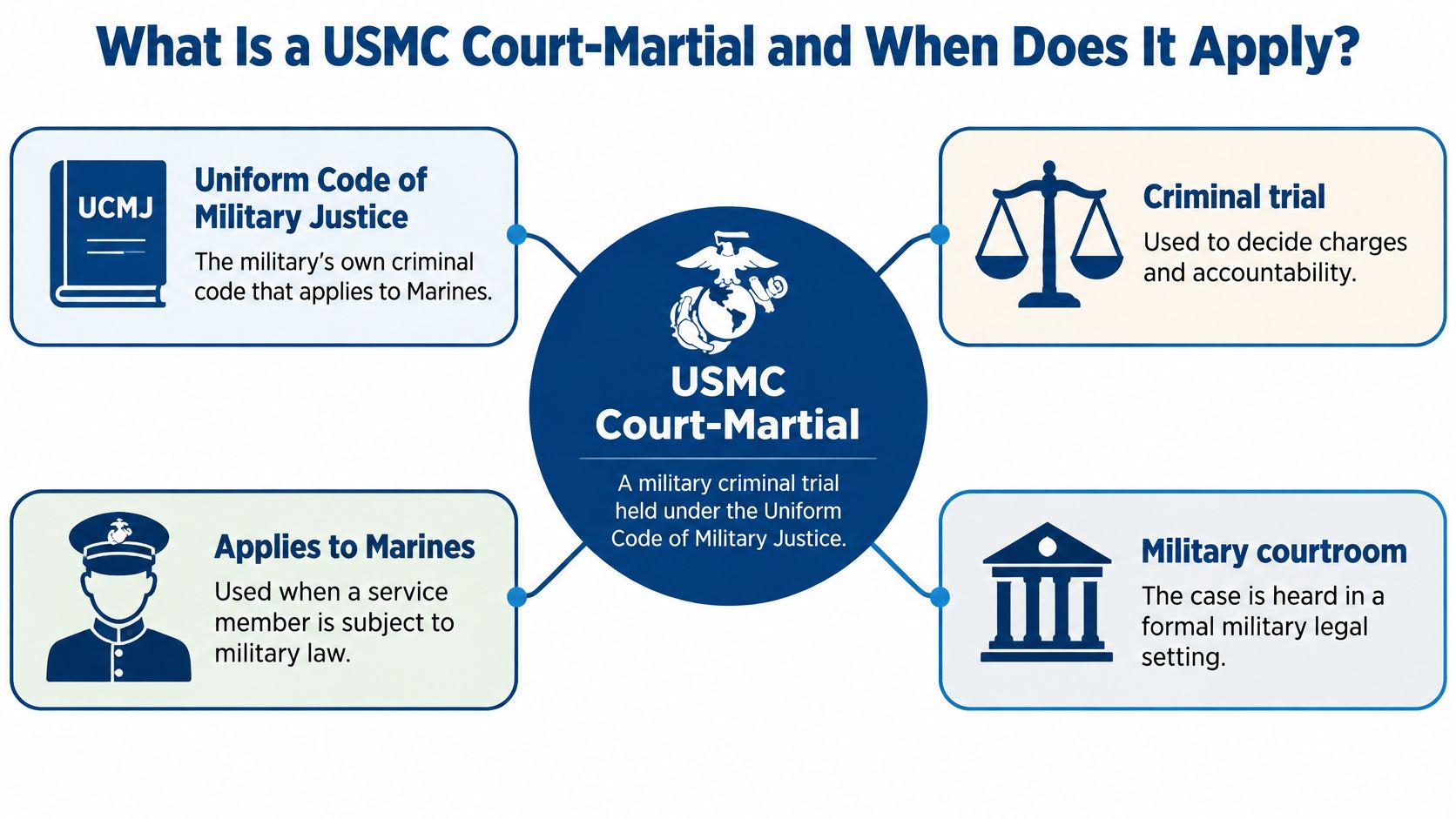
A court-martial decides criminal charges under the Uniform Code of Military Justice, usually called the UCMJ. It isn't the same as a command counseling session, nonjudicial punishment, or an administrative separation board.
Consider a hypothetical Marine accused of taking government equipment. The command must evaluate the evidence and the available response rather than treating every allegation as a trial-ready case.
Which path can an allegation take?
The possible paths include:
- Nonjudicial punishment. NJP is a disciplinary process rather than a criminal trial.
- Administrative action. A command may pursue separation or another personnel action, which addresses continued service rather than criminal guilt.
- Court-martial. A formal criminal proceeding addresses charges through evidence, findings, and, following a conviction, sentencing.
These paths aren't always mutually exclusive. A Marine should have counsel explain whether criminal and administrative proceedings could overlap.
The following concept map distinguishes a court-martial from the broader military disciplinary system.
Does an off-base incident count?
The Marine Corps defense services guidance explains that military jurisdiction can cover conduct both on and off an installation, even when it isn't connected with military duties. When a trial uses a fact-finding panel, its members are military personnel rather than ordinary civilian jurors.
For a Reservist, duty status and the timing of the alleged conduct require particular attention. Counsel should confirm jurisdiction rather than assuming that membership in a Reserve unit answers the question.
The base defense office can explain which services are available for the particular proceeding. Families seeking background can also consult this UCMJ military law guide to become familiar with the language appearing on military paperwork.
What Are the Three Types of Marine Corps Courts-Martial?
The forum matters because it sets procedural protections and limits on punishment. It doesn't establish guilt, and a more serious forum doesn't make conviction automatic.
The hypothetical equipment allegation could receive different treatment based on the specifications, available evidence, and referral decision. The comparison below describes the forums without treating a punishment ceiling as a likely sentence.
The three types of Marine Corps courts-martial
| Type | Who decides | Typical use | Maximum punishment | Key rights |
|---|---|---|---|---|
| Summary court-martial | A commissioned officer who isn't the accused's commanding officer | Minor offenses at the lowest formal level | The applicable summary-court limits under the governing Manual for Courts-Martial | Acceptance or refusal of this forum, attendance, silence, confrontation of witnesses, and a qualifying request for privately retained civilian counsel |
| Special court-martial | A military judge alone or, where authorized, a judge with military members | Intermediate criminal proceedings | The applicable special-court ceiling, offense maximum, and any narrower referral limits | Military defense counsel, privately retained civilian counsel, and opportunities to challenge evidence and present a defense |
| General court-martial | A military judge alone or a judge with military members, subject to applicable rules | The most serious criminal proceedings | The punishments authorized for the proven offenses under the governing sentencing rules | Formal trial protections and preliminary-hearing procedures where required |
According to the Marine Corps summary court-martial rights document, one commissioned officer determines guilt and sentence, and that officer cannot be the accused Marine's commanding officer. The accused may accept or refuse that type of trial.
The officer also has responsibilities involving evidence and witnesses. That structure differs sharply from an adversarial trial with separate prosecution and defense lawyers.
Why isn't there a single reliable punishment number?
A special court-martial is commonly described as the intermediate forum, while a general court-martial can carry much greater exposure. But a forum label alone doesn't establish whether a particular discharge, confinement term, forfeiture, or reduction is authorized.
Officer and enlisted consequences also differ. Officers may face dismissal rather than an enlisted punitive discharge.
Practical rule: A useful exposure assessment identifies the forum, every specification, the governing sentencing rules, and any agreement limiting punishment.
Refusing a summary proceeding doesn't erase the allegation. Counsel should explain the available alternatives and the risk of another forum before the Marine decides.
How Does a Marine Court-Martial Case Move From Investigation to Trial?
A case moves through distinct decisions, not an automatic conveyor belt. The hypothetical equipment case might stop after investigators locate an inventory error, or continue if the evidence supports charges.
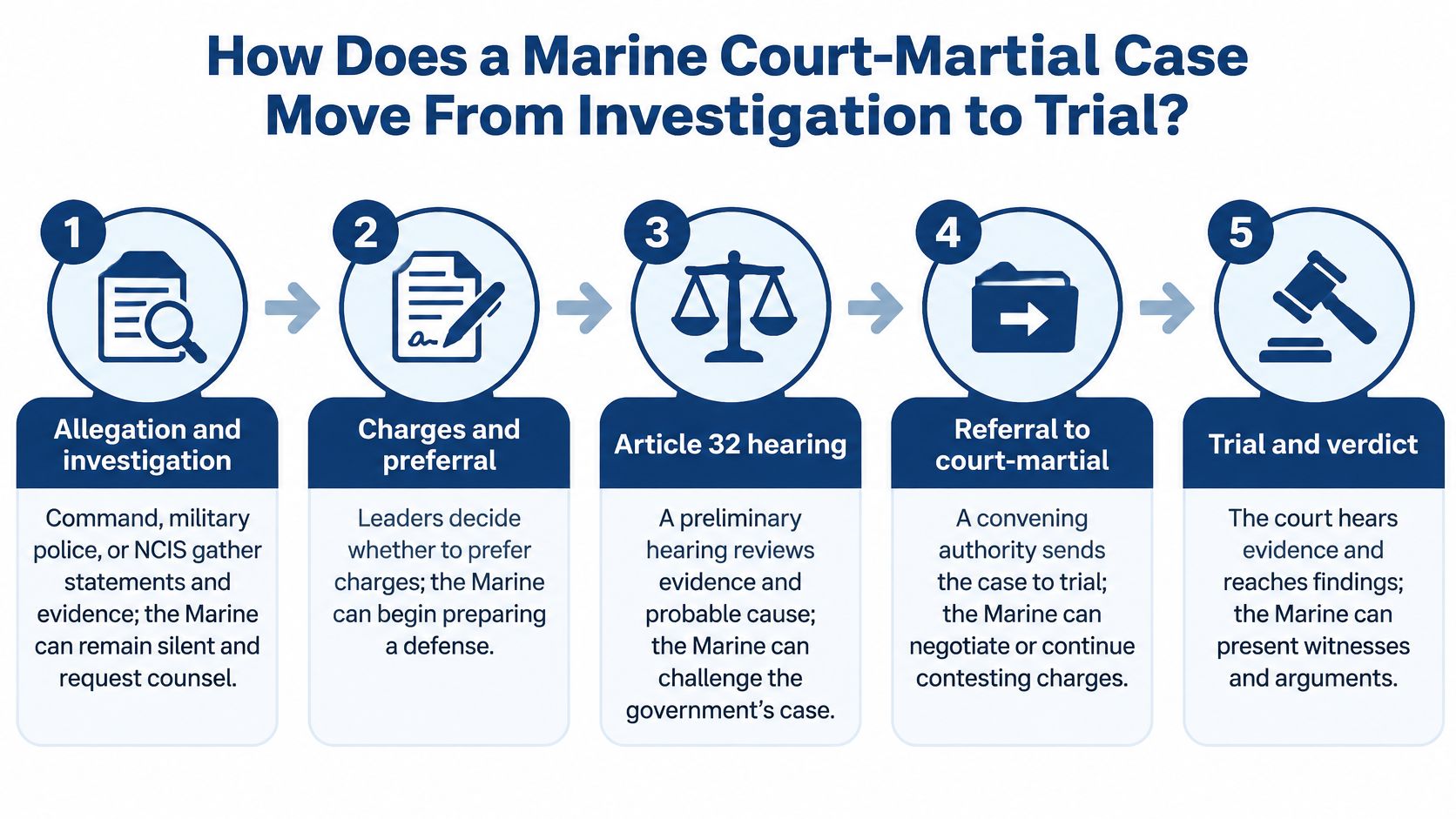
The flowchart provides a broad overview of that progression.
What happens before trial?
Allegation and investigation. Command personnel, military police, or NCIS may collect statements, records, and physical evidence. A Marine approached for questioning should seek defense advice before discussing the facts, rather than assuming an informal conversation carries no risk.
Preferral of charges. A sworn accuser formally signs charges. The defense should examine the actual specifications, which describe the alleged conduct, rather than relying on a verbal description from a supervisor.
Preliminary hearing where required. Certain serious cases involve an Article 32 proceeding. The Marine Corps preliminary-hearing guidance identifies Rule for Courts-Martial 405(h) as governing defense subpoena requests connected with that hearing. Counsel should assess relevant witnesses, documents, and deadlines before the hearing occurs.
Referral. An authorized official sends specified charges to a particular court-martial. That decision identifies the trial forum; it isn't a finding that the Marine committed the offense.
Arraignment and pretrial motions. The court formally addresses the charges and pleas, while counsel raises legal issues under the applicable schedule. Motions may concern statements, searches, discovery, or whether a charge is legally sufficient.
Which preparation matters most?
An Article 32 hearing is not just another command interview. It follows formal procedures, and counsel's ability to obtain evidence requires timely preparation.
The Marine should maintain a private case calendar with counsel, including hearing dates, document requests, and decision deadlines. There isn't a universal schedule that safely replaces the dates in the actual case.
This accompanying video offers another format for reviewing the process.
Cases can end before a contested trial through dismissal, changed charges, or an agreed disposition. The important decision points are the interview, the charging decision, the preliminary hearing, referral, and any proposed agreement.
Should You Use a Military Defense Counsel or a Civilian Lawyer?
Military and civilian defense counsel are options, not quality rankings. A Marine shouldn't assume that a civilian lawyer is automatically more capable or that military counsel is merely a fallback.
The Marine Corps explanation of representation and review states that an accused at court-martial has military defense counsel and may retain a civilian attorney at personal expense. Services available before trial or in administrative matters should be confirmed with the defense office.
Military defense counsel versus civilian military defense lawyer
| Option | Cost | What it gives the Marine | Things to weigh |
|---|---|---|---|
| Marine Corps defense counsel | Free | A uniformed defense lawyer and access to the military defense system | Availability, scope of representation, deadlines, and conflicts |
| Civilian military defense lawyer | Personal expense | A chosen attorney who may offer additional investigation or focused experience | Court-martial experience, written fees, travel, and who performs the work |
| Both together | Civilian fees | Civilian counsel working alongside assigned military counsel | Clear responsibility for strategy, filings, evidence, and communication |
A Marine stationed overseas who faces both criminal charges and separation processing may need coordinated advice across both proceedings. Adding counsel is useful only if responsibilities are clear and the lawyers communicate effectively.
What should a Marine ask before hiring?
Useful questions include:
- Trial experience. How much experience does the lawyer have trying courts-martial to verdict?
- Staffing. Which attorney will handle interviews, hearings, and trial?
- Fees and deadlines. What does the written agreement cover, and which expenses are separate?
- Conflicts. Does representation of another person limit the lawyer's ability to act?
- Coordination. How will civilian and military counsel divide the work?
Promised outcomes, pressure to sign immediately, and unclear fees are warning signs. A consultation should produce a clearer understanding of the case, not a sales deadline.
This site's directory is operated by the military defense business that publishes the guide. Ordinary listings are alphabetical, not rankings or endorsements; a sponsored placement is separately labeled. Location pages place civilian firms alongside available official defense contacts.
What Happens at Trial and How Is the Sentence Decided?
A contested trial separates findings from sentencing. Findings answer whether the government proved the charged offense beyond a reasonable doubt; sentencing addresses the authorized consequence after a conviction.
In the equipment scenario, the government would need to prove the charged conduct, not merely show that an item went missing. The defense might challenge identification, ownership, intent, or the reliability of inventory records.
How does the court decide guilt?
Depending on the applicable rules and forum, a military judge or a panel of military members decides the findings. Counsel should explain available forum elections, panel eligibility, and voting requirements before an election is made.
The defense can challenge government evidence and present witnesses or records supporting its position. An acquittal on a specification means no sentence may be imposed for that acquitted offense.
What affects the sentence?
Sentencing isn't a repeat of the findings arguments. The government may present aggravating evidence, while the defense develops relevant mitigation.
Potential mitigation materials include:
- Service performance. Evaluations, awards, and documented responsibilities.
- Personal circumstances. Relevant family obligations and other supported background facts.
- Rehabilitation evidence. Concrete steps and reliable testimony addressing future conduct.
Under Article 56, 10 U.S.C. § 856, discussed in this Department of Justice filing, the President may prescribe or limit maximum punishments. Counsel therefore must identify the offense date, applicable Manual for Courts-Martial, and governing sentencing limits before estimating exposure.
Potential punishment categories include confinement, a punitive discharge or dismissal where authorized, reduction, forfeitures, and reprimand. Not every category is available in every case.
A maximum sentence is a legal ceiling, not a forecast of the sentence a particular Marine will receive.
Hypothetical: Similar equipment allegations referred to different forums can carry different exposure. Even within the same forum, different specifications or an agreement can change the legally available result.
An announced sentence also doesn't answer every question about confinement credit, later review, or the final judgment.
What Happens After the Verdict and Can a Court-Martial Be Appealed?
A trial result and a final judgment aren't interchangeable. Post-trial procedures, applicable agreements, confinement credit, and appellate rulings can affect what the result means in practice.
A Marine and family should obtain a case-specific explanation of what happens immediately, what remains subject to review, and which deadlines require action.
What is the post-trial sequence?
The broad sequence includes:
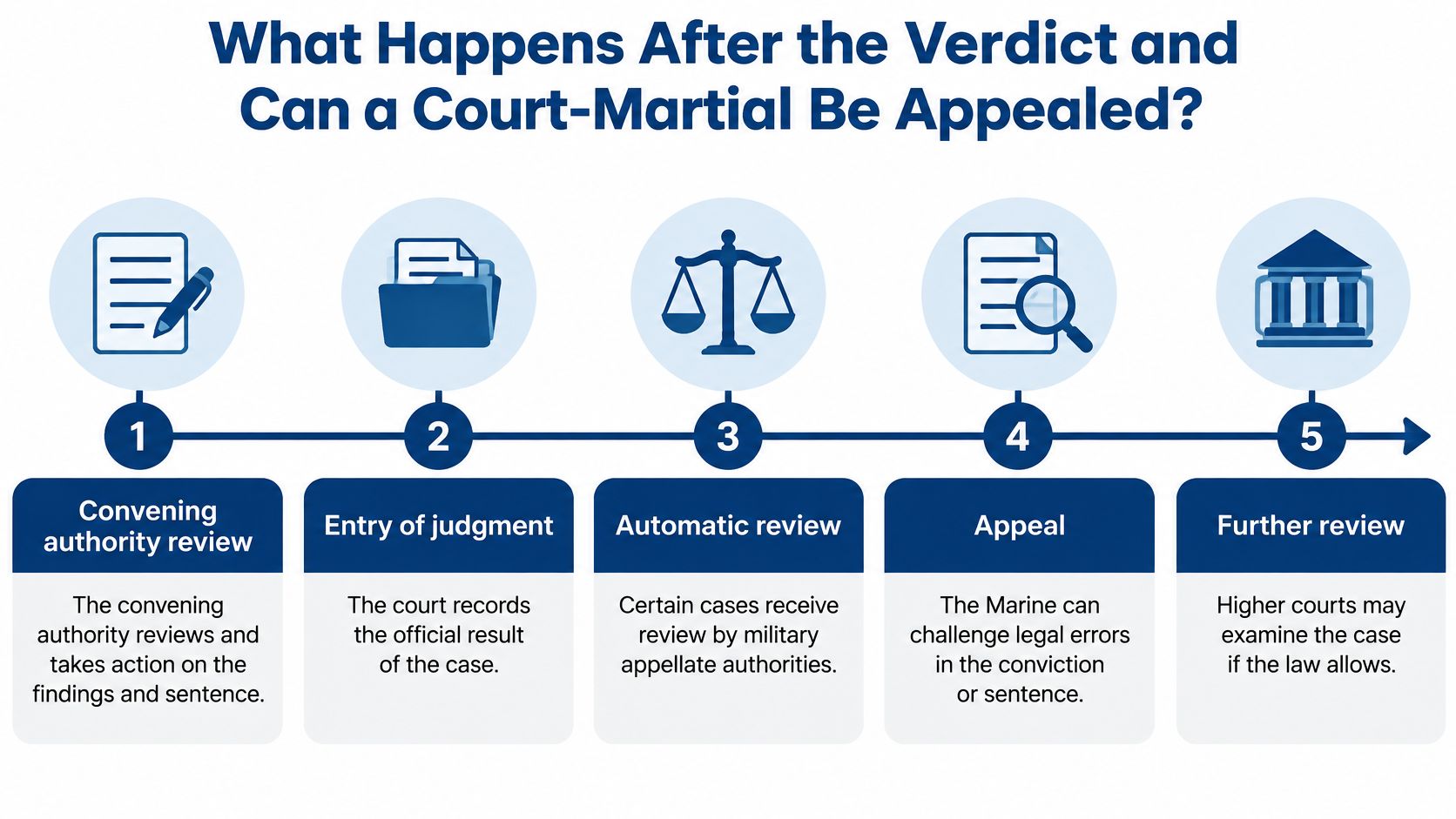
- Post-trial submissions and authorized action. Counsel reviews available requests and any action the convening authority may lawfully take. That authority isn't an unrestricted power to rewrite the verdict.
- Entry of judgment and applicable review. The official result is recorded, and the case follows the review route required or available under governing law.
- Further appellate proceedings. Eligible cases may reach a Court of Criminal Appeals and, in appropriate circumstances, the U.S. Court of Appeals for the Armed Forces.
The following timeline illustrates the main stages, but eligibility and the scope of review require individual legal analysis.
Why aren't monthly results win-rate data?
The Marine Corps court-martial reports publish monthly general- and special-court-martial dispositions. A short entry can identify an outcome without supplying enough context to compare it fairly with another case.
Readers should check:
- Charge versus finding. An accusation listed in a report isn't necessarily an offense of conviction.
- Procedural stage. The reported sentence may not describe the final result after review.
- Missing context. Plea terms, evidentiary rulings, sentencing rules, and later changes may not be apparent.
A conviction count doesn't measure a lawyer's performance. An acquittal count doesn't explain what charges were negotiated away, and an announced sentence doesn't establish time served.
Meaningful comparison requires the charges, forum, plea posture, governing rules, and post-trial history. A headline result alone can't predict another Marine's outcome.
What Should You Do Next if You Face a Court-Martial?
An accusation starts a process, not a verdict. The first days are most useful for protecting evidence, understanding paperwork, and establishing reliable communication with counsel.
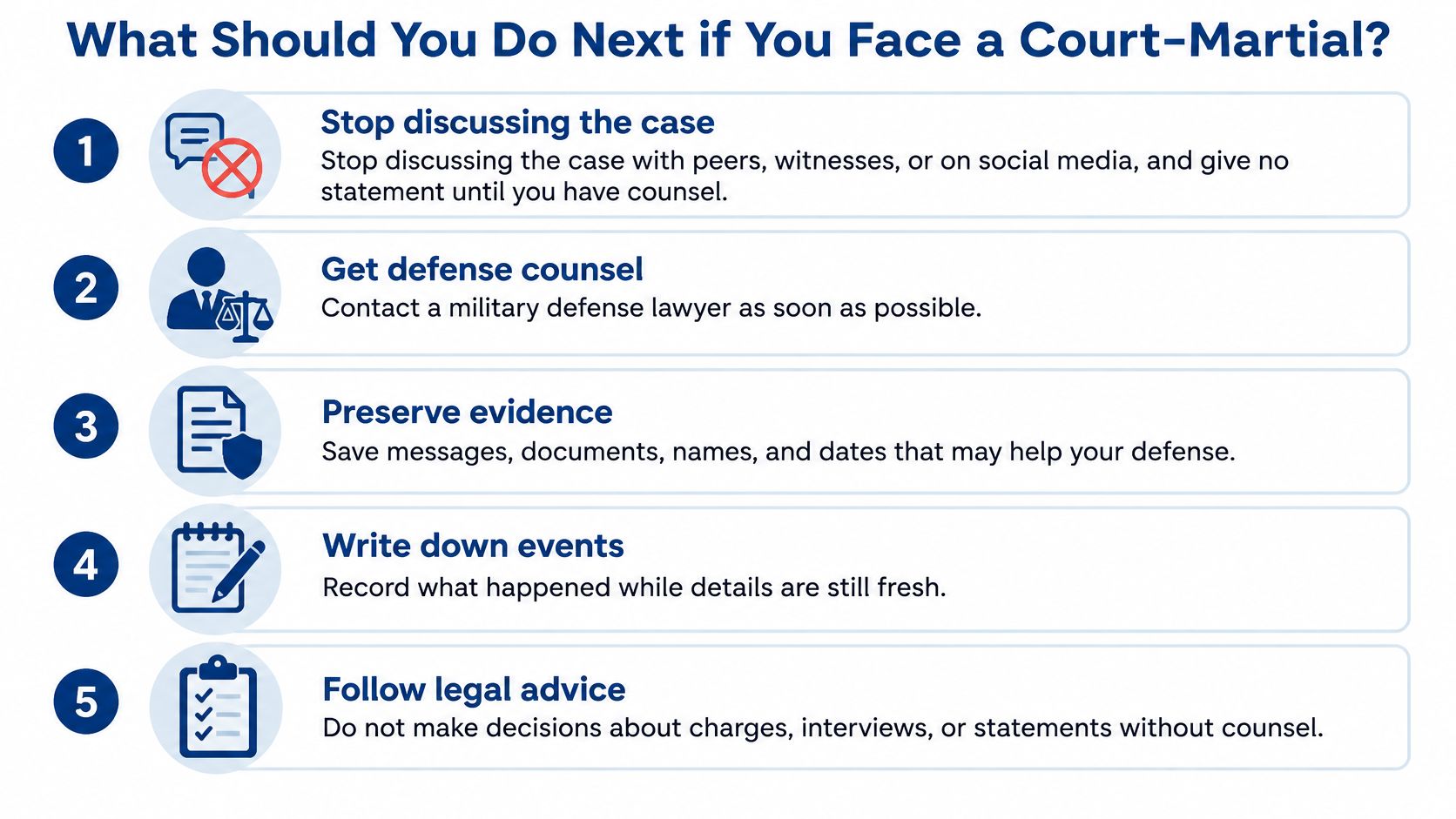
This checklist highlights the immediate priorities.
What should happen during the first days?
Limit case discussions. The Marine should avoid debating the allegation with peers, witnesses, or social media audiences. Any request for a statement should prompt consultation with defense counsel.
Contact the defense office. The Marine should provide the paperwork received and ask about representation, interview requests, and upcoming deadlines. Family members can help organize logistics without taking over confidential legal discussions.
Get advice before accepting or waiving anything. NJP decisions, signed statements, agreements, and waivers can affect later options. Counsel needs the actual document, not a summary of what someone said it means.
Preserve evidence without altering it. Messages, emails, photographs, receipts, and location records should remain intact. The Marine shouldn't delete material, coordinate accounts with witnesses, or seek restricted records without authorization.
Create a private chronology for counsel. Dates, locations, participants, and possible witnesses help identify missing evidence. Uncertain memories should be marked as uncertain rather than filled in.
Review the specifications and representation plan. Counsel should explain each allegation, authorized exposure, and whether additional civilian assistance would serve a defined need.
Plan for practical consequences. Pay, clearance issues, duty restrictions, transportation, and family arrangements deserve attention alongside trial preparation.
Where can a family locate contacts?
For a Marine assigned there, the Camp Pendleton defense-lawyer and base-contact page offers a location-specific starting point. Official defense contacts should be verified before sensitive documents are sent.
Quiet preparation is more useful than public argument. A current document folder and a counsel-approved calendar give the Marine something concrete to manage.
Frequently Asked Questions About USMC Courts-Martial
Can family members watch a court-martial?
Courts-martial are generally public, although a judge can restrict access to particular portions when legally justified. Families should confirm the hearing schedule, installation access requirements, and any courtroom restrictions before traveling.
How long does the process take?
There isn't a fixed duration that fits every case. Evidence collection, motions, witness availability, the forum, and appellate proceedings affect the schedule, so counsel should explain the next expected milestone rather than promise a completion date.
Does a conviction affect civilian life or veterans' benefits?
Consequences turn on the conviction, sentence, discharge, and the rules governing the particular benefit or application. Employment disclosures, professional licensing, and veterans' benefits require separate review rather than a single general answer.
The site's military law answers can help families identify follow-up questions for counsel. Individual advice remains necessary before making decisions about a pending case.
The UCMJ Military Defense Lawyer Directory offers location-based civilian lawyer listings alongside official military defense contacts, helping Marines and families identify representation options for investigations and courts-martial. Families can visit the relevant installation page, verify contact information, and prepare the charging paperwork for a consultation.
This article is general information, not legal advice. Laws vary by state and change over time. Talk to a licensed attorney about your situation.