An Air Force court-martial may seem like one dramatic event: charges read aloud, a courtroom, a verdict. The harder truth is that the outcome is usually shaped weeks earlier, in decisions about the forum, the member's duty status, the plea, and who sits at the defense table. Those are the choices a service member can still act on.
An Air Force court-martial is also less common than expected. An Air Force Judge Advocate General publication reports that Air Force courts-martial fell 35% between 1965 and 1980, and that since 1985 the annual rate has stayed between 2.54 and 2.39 courts-martial per 1,000 Air Force personnel. Uncommon still means serious, so each stage below comes with the decision it puts in front of the member.
Table of Contents
- Summary, Special and General Courts-Martial Compared
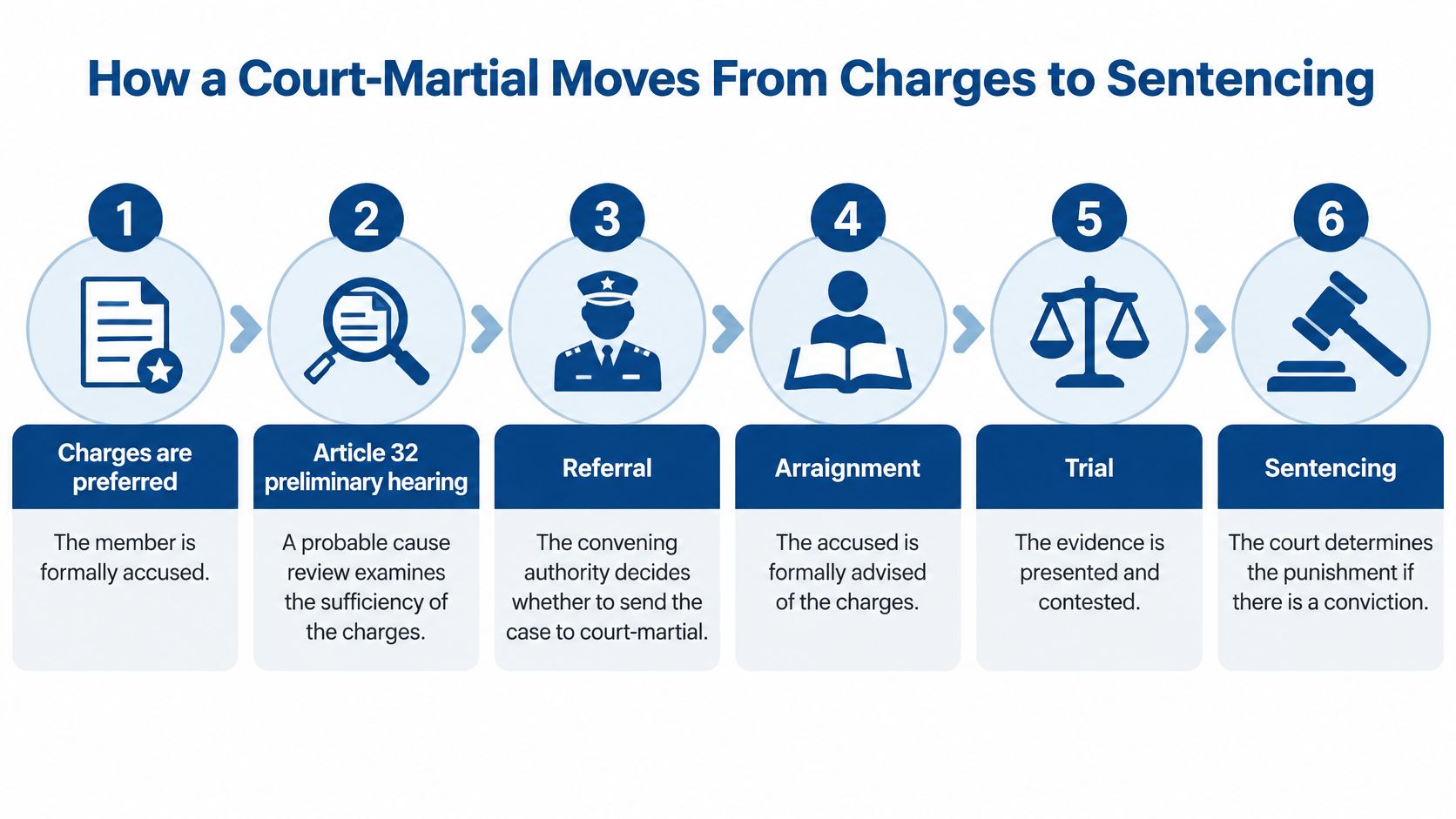
- How a Court-Martial Moves From Charges to Sentencing
- What Rights and Jurisdiction Apply Before Referral
- What Charges and Article 15 Mean Under the UCMJ
- Pretrial Agreements and the Plea Decision
- Choosing Free Defense Counsel or a Civilian Lawyer
- What to Do Next If You Are Facing Charges
- Frequently Asked Questions
Summary, Special and General Courts-Martial Compared
An Air Force court-martial isn't a single proceeding. It's one of three forums, and the forum decides how serious a case can be and how much punishment can follow. The Uniform Code of Military Justice creates a tiered system of summary, special, and general courts-martial, and the tier is the first thing to pin down, as an Air Force JAG commentary on the UCMJ explains.
The tiers work like three lanes of increasing speed. A summary court-martial handles comparatively minor misconduct and is normally conducted by one commissioned officer rather than a military judge. A special court-martial is the intermediate forum, and it can impose up to 12 months of confinement, forfeiture of two-thirds pay per month for 12 months, and a bad-conduct discharge for enlisted personnel. A general court-martial carries the maximum punishment set for each charged offense in the Manual for Courts-Martial, which can include lengthy confinement, a punitive discharge, dismissal of an officer, and, where the law authorizes it, death.
| Forum | Who conducts it | Typical use | Punishment limits |
|---|---|---|---|
| Summary court-martial | One commissioned officer | Comparatively minor misconduct | For enlisted members, up to 30 days confinement, reduction to E-1, and forfeiture of two-thirds pay for one month, per the Manual for Courts-Martial |
| Special court-martial | Military judge, with or without members | Intermediate cases | Up to 12 months confinement; forfeiture of two-thirds pay per month for 12 months; bad-conduct discharge for enlisted personnel |
| General court-martial | Military judge, with or without members | Most serious cases | Maximum punishment set for each charged offense in the Manual for Courts-Martial, possibly including punitive discharge, dismissal and, where authorized, death |
Forum selection drives both sentencing exposure and the safeguards the accused receives. A general court-martial, for instance, generally requires an Article 32 preliminary hearing before referral unless the accused waives it, which is why defense counsel looks at the intended forum before looking at the evidence. The referral decision happens outside the courtroom, yet it fixes the ceiling on everything that follows inside it.
Ask first: Which forum is the command aiming for, what is the maximum punishment on every charge and specification, and which pretrial safeguards come with that forum?
How a Court-Martial Moves From Charges to Sentencing
Delay and pressure both cluster at specific points, so the order matters.
- Charges are preferred. A commander or other authorized person formally accuses the member on a charge sheet.
- An Article 32 preliminary hearing reviews the case. For a general court-martial, this hearing examines probable cause, whether the charges and specifications are sufficient, and what disposition is recommended, unless the accused waives it.
- The convening authority decides on referral. That decision sets the forum, and the forum sets the sentencing exposure.
- The accused is served with the referred charges. A waiting period before trial begins to run; the Manual for Courts-Martial sets the exact number of days, so confirm the current rule in the case at hand.
- Pretrial motions and Article 39(a) sessions resolve legal issues. Suppression questions, pleas and other contested matters get handled before findings.
- Trial, then sentencing. Findings come first, and if there is a conviction, sentencing follows, sometimes with a negotiated cap on what can be approved.
Timelines split sharply by forum. An official Air Force military-justice analysis covering January 2007 through June 2010 reviewed 2,568 courts-martial. Of those, 797 (31.03%) were litigated and 1,771 (68.96%) were apparent guilty pleas, so the plea decision alone changes the calendar (Air Force military-justice analysis).
| Benchmark | Special court-martial | General court-martial |
|---|---|---|
| Completion target (80% of cases) | Within 75 days | Within 160 days |
| Cases meeting the completion target | 70% | 49% |
| Average time to completion | 75 days | 201 days |
| Courts convened within 45 days of service | 81% | 36% |
The same analysis found the Air Force met its own 160-day standard in only 49% of general courts-martial, averaging 201 days, while special courts averaged 75 days. On convening within 45 days of service, general courts hit 36% against special courts at 81%.
Practical rule: Ask defense counsel for the current date range in this specific case, not the service average. A single contested motion can move a general court-martial well past the numbers above.
What Rights and Jurisdiction Apply Before Referral
A member doesn't have to wait for charges to use their rights. The right to counsel and the right to remain silent apply during law-enforcement interviews and disciplinary investigations, as the Air Force Area Defense Counsel program explains. Article 31 warnings tell a member that anything said can be used against them. Asking for a lawyer is not an admission of anything.
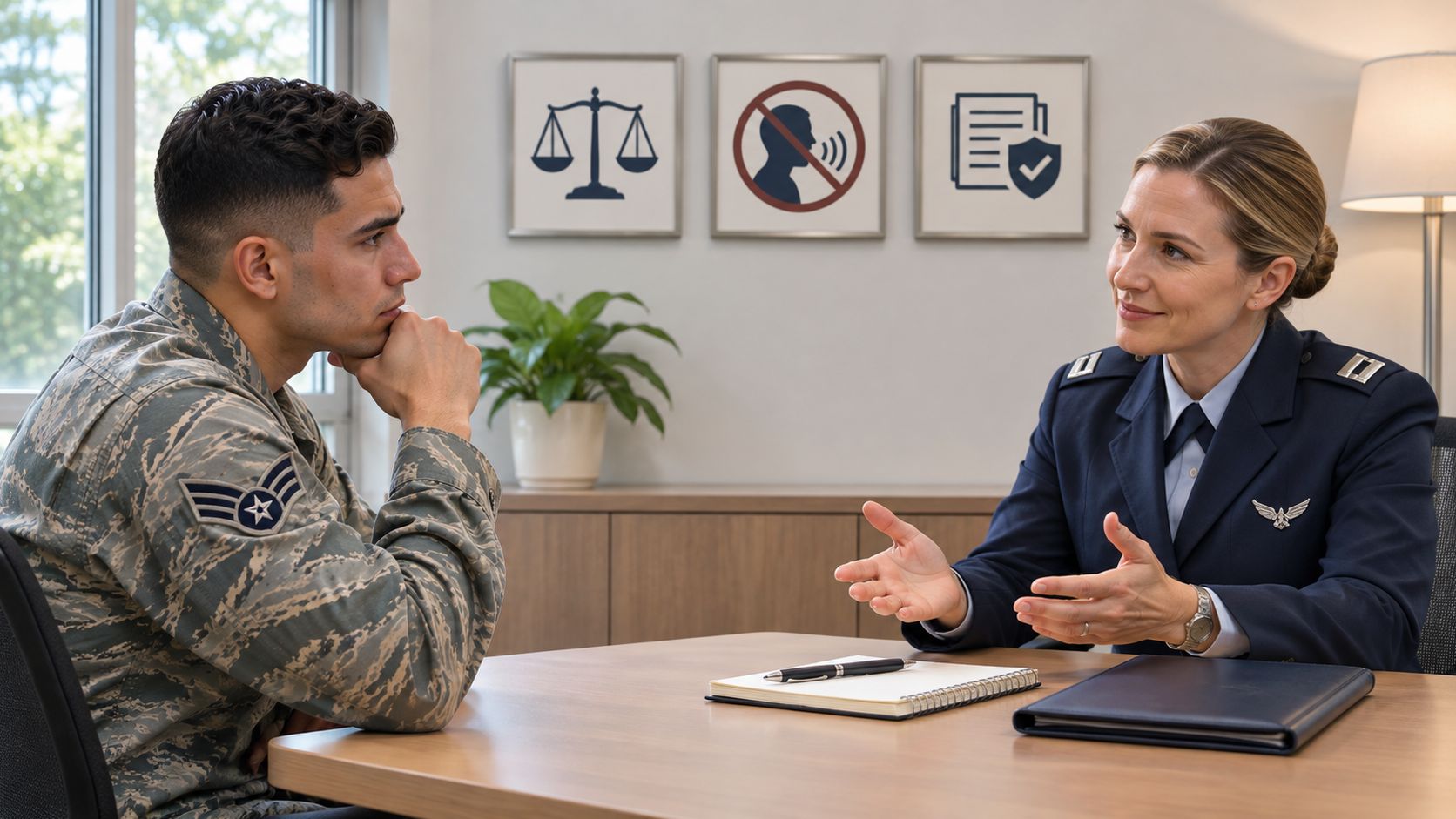
That same guidance states that seeking counsel can't be held against an Airman, even if the member has already made statements or consented to a search. Most pressure arrives before referral: questioning by OSI or Security Forces, a search of a room, a locker or a phone, an Article 15 being considered, a reprimand, or an administrative action running alongside everything else.
Jurisdiction Can Turn on Duty Status
Reserve and Guard members should look closely here. Articles 2(a)(1) and 2(a)(3) of the UCMJ extend court-martial jurisdiction to reservists in a Title 10 status, including inactive-duty training, active duty, and annual training, according to Air Force legal guidance on military justice. The same alleged conduct can therefore raise different jurisdictional questions depending on the member's status when it happened and when the command acts. Orders, pay records, drill attendance, and travel authorizations stop being paperwork and become evidence.
Inactive status doesn't automatically block jurisdiction either. Reserve members who aren't on active duty may be involuntarily ordered to active duty for an Article 32 investigation, court-martial, or Article 15 proceeding when the alleged offense happened while they were on active duty or federal inactive-duty training (Air Force guidance on recall to active duty). That guidance also limits punishment for a recalled member, since confinement or restriction outside a training period generally requires Secretary of the Air Force approval.
Overseas cases add host-nation questions that shift by country. If a video appearance is proposed, the member should ask before agreeing how confidential consultation with counsel will happen. Rules differ by branch and by status, so confirm the specifics rather than assuming Air Force practice carries over everywhere.
What Charges and Article 15 Mean Under the UCMJ
The UCMJ defines the punitive offenses, and each one has elements the government has to prove. Charges appear on a charge sheet, and each specification states the alleged act, the date, and the place.
Take a neutral example: unauthorized absence. The elements are that the member was absent from their unit, that the absence was without authority, and that it lasted for a stated period. Defense counsel tests each element against the evidence, checks the charge sheet for pleading errors, and raises motions where the process itself went wrong.
Article 15 is the other path. A commander can impose nonjudicial punishment for minor misconduct without any court-martial. In many situations a member may turn down Article 15 and ask for trial by court-martial instead, but that trade depends entirely on the case and shouldn't be made without advice.
- Who decides: A commander imposes Article 15 punishment; a military judge or panel decides a court-martial.
- Whether there's a trial: Article 15 involves no trial and no finder of fact beyond the commander.
- Range of punishment: Article 15 penalties are capped and nonjudicial; a court-martial can impose confinement and a punitive discharge.
Article 15 procedures differ by branch, which trips up families comparing advice from different services. The UCMJ military law guide sets out how the punitive articles and the forums fit together.
Pretrial Agreements and the Plea Decision
A pretrial agreement trades action by the convening authority for a plea or for waived procedural rights. Air Force Judge Advocate General materials describe terms that can require the accused to plead guilty to selected charges and specifications, accept a stipulation of facts, or waive an Article 32 investigation, trial by members, or the personal appearance of sentencing witnesses (Air Force JAG materials on pretrial agreements).
In return, the convening authority may agree to withdraw charges or specifications, refer the case to a lower level of court-martial, treat a capital offense as noncapital, or cap the sentence that may be approved.
The Adjudged Sentence and the Approved Sentence Are Different Numbers
Readers often get lost here. The sentence announced in the courtroom and the sentence the convening authority may approve are two separate figures. Air Force case summaries show negotiated maximums of 10 years or 14 months of confinement alongside the sentence adjudged at trial (Air Force court-martial summaries). The agreement restricts what can be approved. It doesn't erase what the judge or members announced.
Before signing anything: An agreement cannot lawfully strip fundamental protections such as the right to counsel, due process, a jurisdictional challenge, a speedy trial, or a complete sentencing proceeding.
Questions worth putting to counsel: Which specifications am I pleading to? What exact cap applies, and on which parts of the sentence? What am I giving up in the process? What happens if the convening authority rejects the deal or the plea falls apart later? Review every waiver and every sentencing limit with defense counsel before a signature goes on the page.
Choosing Free Defense Counsel or a Civilian Lawyer
Two options exist, and they aren't mutually exclusive. Free defense counsel comes through the Air Force Area Defense Counsel program, which can represent Airmen at investigations, at Article 15, in separation actions, and at trial. A civilian military defense lawyer is retained at the member's expense and can work alongside detailed military counsel or instead of it. Air Force procedural guidance states that an accused has the right to detailed military counsel, civilian counsel, or military counsel of choice when reasonably available (Air Force procedural guidance).
| Option | Who pays | When it is available | What to confirm |
|---|---|---|---|
| Air Force defense counsel (ADC) | No cost to the member | Through the base legal office, including before charges are referred | Which stages the ADC will cover, such as investigations, Article 15 and separation actions |
| Civilian military defense lawyer | The member | At any stage, alone or alongside ADC | Court-martial experience, fee structure and communication plan |
| Military counsel of choice | No cost to the member, since the counsel is military | When reasonably available | Whether the requested counsel is reasonably available |
Vetting a civilian lawyer comes down to a short list of questions:
- Court-martial experience: How many courts-martial have they handled, and at which forums?
- Familiarity with the setting: Do they know this branch, this installation and its convening authority practice?
- Fees: Is the fee flat, hourly, or staged, and what costs sit outside it?
- Appearances: Can they appear in person, and how do they handle remote or overseas proceedings?
- Confidential communication: How will privileged calls and documents be protected?
This site's overseas military defense lawyer directory lists civilian firms by country and installation next to the free defense counsel contacts. Listings are alphabetical and not ranked or scored, and a member can use free counsel, hire a civilian lawyer, or do both.
What to Do Next If You Are Facing Charges
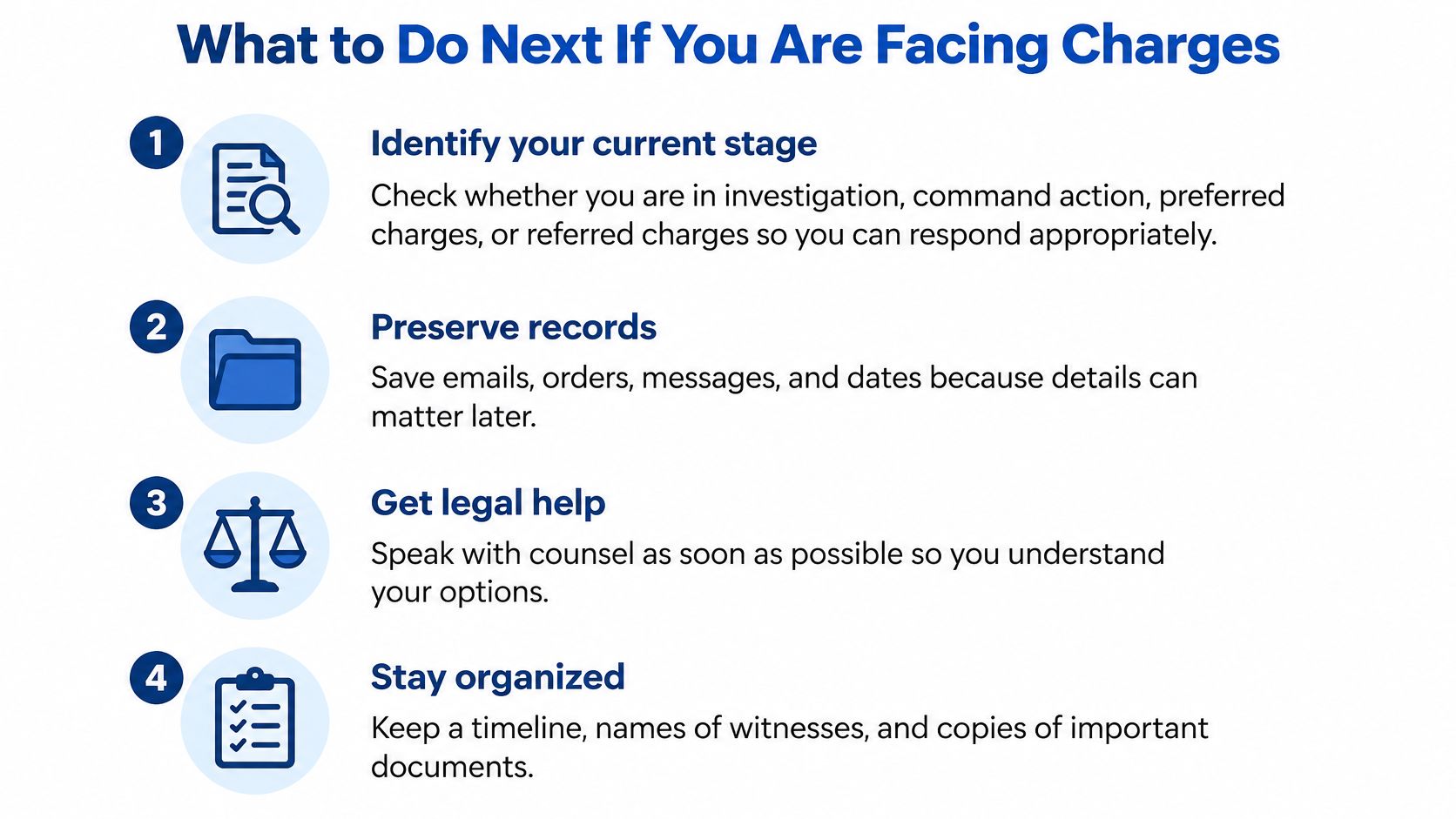
- Identify your current stage. Investigation, command action, preferred charges, or referred charges. Each one carries different deadlines, and the answer changes what to do this week.
- Preserve records now. Orders, pay and duty records, drill attendance, travel authorizations, emails and messages. Duty status can decide jurisdiction later, so treat the paperwork as evidence.
- Ask counsel three questions. Which forum is intended, what the maximum punishment is for each charge, and whether a pretrial agreement is worth discussing at all.
- Confirm status and location. Whether a remote appearance has been raised, and which defense office handles the case.
- Compare counsel options. Free ADC support, a civilian lawyer, or both, using the vetting list above. The UCMJ Military Defense Lawyer Directory searches by state, base, or overseas location.
For the rules on silence and counsel during questioning, the rights section above applies at every one of these steps.
Frequently Asked Questions
Can I get a free lawyer for an Air Force court-martial?
Yes. The Air Force Area Defense Counsel provides defense counsel at no cost, and a member may also hire a civilian military defense lawyer at their own expense. Using both together is allowed.
Does asking for a lawyer look bad?
No. Seeking counsel shouldn't be held against a member, even after statements were made or a search was consented to. Confirm the specifics of the situation with counsel rather than deciding alone.
How do summary, special and general courts-martial differ?
The forum sets the maximum punishment. A summary court-martial handles comparatively minor misconduct, a special court-martial is the intermediate forum, and a general court-martial is the most serious, with the maximum set for each charged offense in the Manual for Courts-Martial.
Do the rules change by branch or duty status?
Yes. Rules differ by branch, by duty status, and by location, and Reserve or Guard members can face different jurisdictional questions than active-duty members. The military law answers library covers related questions in the same plain format.
This article is general information, not legal advice. Laws vary by state and change over time. Talk to a licensed attorney about your situation.
A court-martial case turns on early choices: the forum, the duty status on the day of the alleged conduct, the plea, and the counsel standing beside the member. The UCMJ Military Defense Lawyer Directory at UCMJ Military Defense Lawyer Directory lists civilian military defense lawyers by state, base and overseas location, alongside the free defense counsel office at each installation, so a member under pressure can compare options in one place instead of starting from a blank search page.