A letter of reprimand is a formal written administrative censure issued when a service member is alleged to have failed to meet established standards, policies, or duties, and it is not itself Article 15 punishment or a court-martial conviction.
But does receiving the letter tell the whole story about its career impact? Not necessarily. Where the reprimand is filed can matter more than its issuance, and the response period is the point when that filing outcome may still be open.
Table of Contents
- What a Letter of Reprimand Means
- Where a Reprimand Is Filed and How Long It Stays
- What Career Effects Can Follow a Reprimand
- How a Reprimand Moves From Notice to Filing
- How to Respond to a Reprimand
- What to Do Next and When to Call Defense Counsel
- Common Questions About Letters of Reprimand
What a Letter of Reprimand Means
A letter of reprimand (LOR) records an official concern about a service member's conduct or performance. Unlike a spoken warning, it creates a written record that may be considered in later personnel decisions.
In the Army, a General Officer Memorandum of Reprimand (GOMOR) is a specialized reprimand issued by a general officer or an officer exercising general courts-martial jurisdiction. The Fort Jackson GOMOR information sheet explains that Army Regulation 27-10 requires the document to identify itself as an administrative measure, not Article 15 punishment.
Reprimand types compared with other military discipline
| Type | Who issues it | Administrative or punishment | Where the record can go |
|---|---|---|---|
| Letter of reprimand (LOR) | Commander or supervisor under branch rules | Administrative, not Article 15 punishment | Local file or permanent record under the applicable filing authority |
| GOMOR (Army) | General officer or officer with general courts-martial jurisdiction | Administrative, not Article 15 punishment | Local file, AMHRR performance section, or restricted section when authorized |
| Article 15 nonjudicial punishment | Commander with Article 15 authority | Punishment under UCMJ Article 15 | Records designated by the branch's nonjudicial-punishment filing rules |
| Court-martial | Convened by a court-martial convening authority | Judicial proceeding; a conviction is separate from a reprimand | Court-martial records and personnel records under applicable rules |
A reprimand is like a formal correction placed in a file. The file's location helps determine how long the correction remains visible and who can consider it.
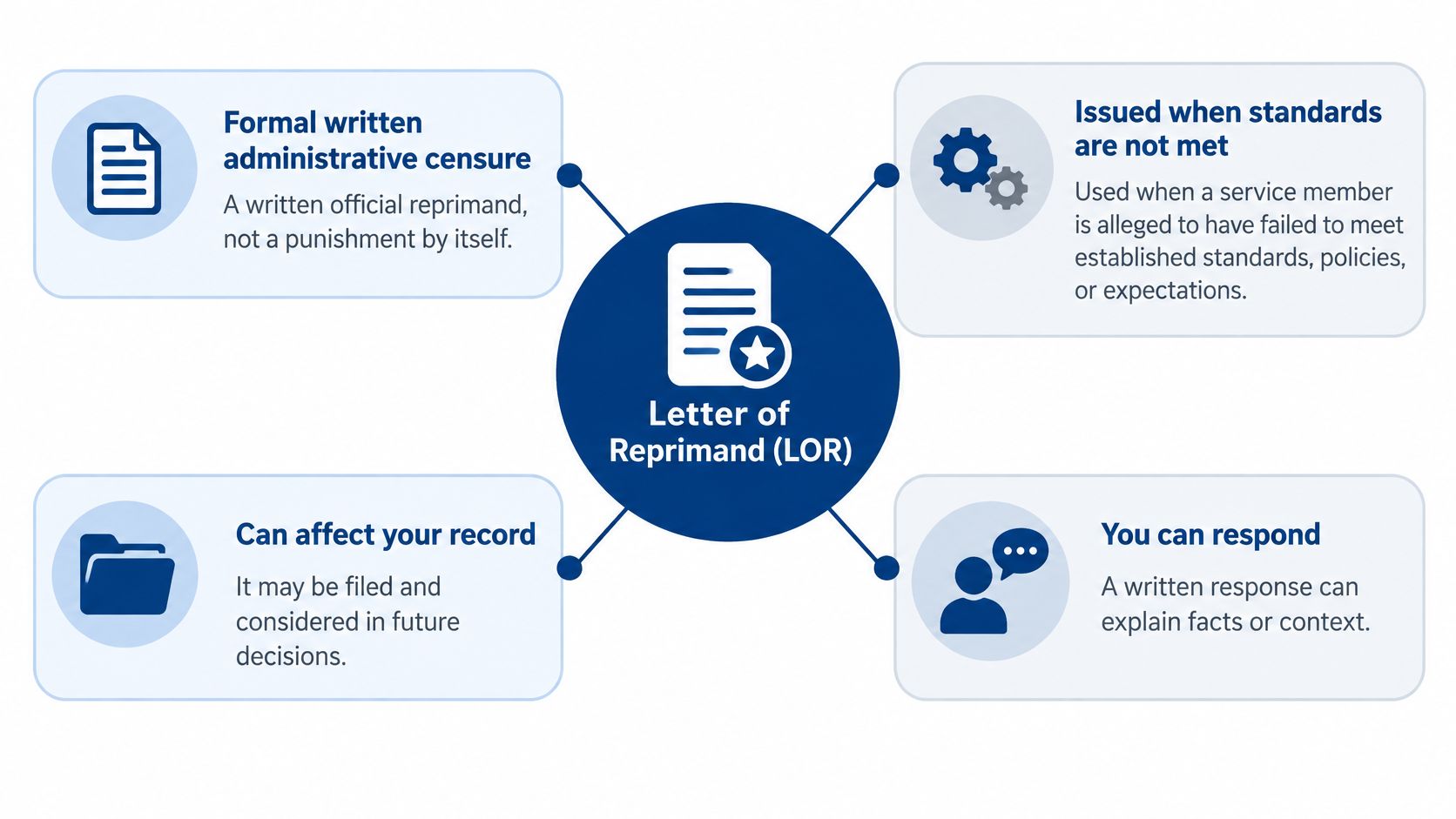
The UCMJ military law guide provides broader context for these separate military processes. Branch and situation change the rules, but the Army classifies a reprimand as unfavorable information, which gives the recipient an opportunity to respond before filing.
Where a Reprimand Is Filed and How Long It Stays
The filing decision determines who may encounter the reprimand later. Army terminology can be confusing because guidance may refer to the Army Military Human Resource Record (AMHRR) or the older Official Military Personnel File (OMPF) terminology.
The main distinction is between a locally kept document and a document placed in the official career record. Restricted filing is another possibility when authorized, but it shouldn't be mistaken for local filing.
Army filing locations for a reprimand and their career effects
| Filing location | What it is | Typical duration | Career effect |
|---|---|---|---|
| Local Military Personnel Record Jacket (MPRJ) | Locally kept personnel file | Temporary, subject to the governing retention and reassignment rules | Generally less visible and intended to allow continued service |
| AMHRR performance section | Permanent part of the official Army record | Permanent | Can be reviewed for evaluations, promotion, assignments, and retention |
| AMHRR restricted section | Restricted-access part of the official record, when authorized | Governed by applicable AMHRR retention and removal rules; not a local-file expiration | Narrower access than the performance section |
For local filing, the Fort Moore GOMOR fact sheet states a retention period of up to 18 months or until reassignment to a new general court-martial jurisdiction, whichever happens first. That rule shouldn't be treated as a universal deadline for every installation or situation.
The Army Stuttgart reprimand guide instead describes local retention of up to three years or reassignment, whichever occurs first. These differing descriptions make the actual notice and governing authority important.
What should the recipient check?
Performance-section filing places the reprimand in the permanent career record, rather than a temporary local file. Restricted-section filing limits access, but it doesn't turn the document into a locally held warning.
The issuing authority may consider the allegations, the Soldier's response, and the surrounding circumstances when deciding where to file the reprimand. The recipient should identify:
- Proposed location: Whether the notice proposes local, performance-section, or another authorized filing.
- Response deadline: The stated date for submitting written matters.
- Controlling procedure: The regulation and instructions governing that particular action.
Practical rule: A request for local filing is a request for a different record outcome, not simply a different label.
An unclear notice warrants prompt clarification. Assuming that every reprimand expires automatically can cause a service member to overlook the decision with the longest-lasting effect.
What Career Effects Can Follow a Reprimand
A reprimand isn't always a warning that fades on its own. Personnel officials may consider a permanently filed document when making decisions about advancement, assignments, continued service, or separation.
Consider a Soldier who later competes for promotion. A GOMOR placed in the permanent performance record may be available to the promotion board. If the same reprimand were filed only locally, the board's access and the contents of the official career record would be different.
That comparison doesn't establish what the board will decide. Visibility creates a possible consequence, not a guaranteed result. The Soldier's branch, record, filing location, and the decision-makers all matter.
A serious administrative consequence doesn't make the reprimand itself a criminal conviction.
The letter may also accompany another administrative or disciplinary action. A recipient should therefore read the entire packet, not just the reprimand's opening paragraph, and look for notices addressing separate proceedings.
Useful questions include:
- Other action: Does the packet identify another pending process?
- Decision at stake: Is the immediate issue filing, or is a separate retention decision also involved?
- Requested result: Would withdrawal, local filing, or another authorized outcome address the concern?
A response should focus on the decision before the authority. A statement about dedication alone may leave the central filing question unanswered.
How a Reprimand Moves From Notice to Filing
The Army process connects an allegation to a later record decision. The Army Monterey guide to GOMORs and letters of reprimand explains the response opportunity and the distinction between local and permanent filing under Army Regulation 600-37.
Alleged misconduct leads to a written reprimand. The recipient should identify the conduct alleged and the proposed filing. Receiving an allegation isn't the same as agreeing that it is accurate.
The recipient receives an opportunity to respond. Because the Army treats the document as unfavorable information, written matters can be submitted before the filing decision. The notice is the first place to check the deadline and submission instructions.
The recipient prepares the factual record. Preserving the original letter and listing each allegation helps prevent omissions. The response should also identify the desired disposition, such as withdrawal or local filing.
The authorized official decides the disposition. The recipient may request an outcome but doesn't control the decision. Permanent filing of a general officer reprimand generally requires general officer authority.
The record outcome affects later review. If the document enters the permanent record, personnel officials may encounter it during later decisions. The recipient should retain the final filing decision along with the response.
The process can be visualized as a sequence of separate decisions.
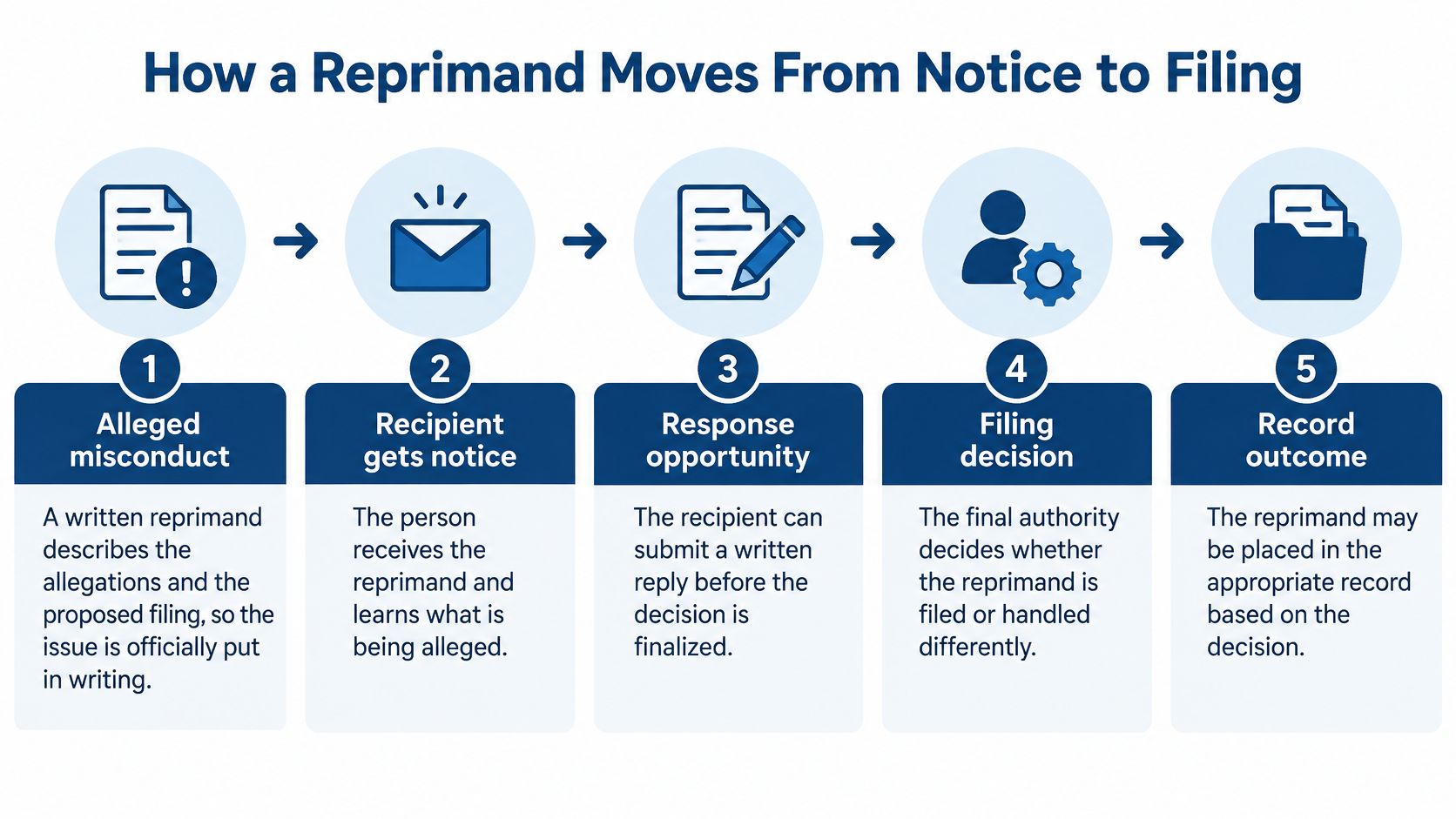
The response window is a chance to influence an unresolved decision, not merely an acknowledgment that the letter arrived.
Exact procedures differ by branch and governing regulation. A deadline from another service member's case shouldn't replace the deadline in the recipient's own notice.
How to Respond to a Reprimand
A useful response addresses both the alleged conduct and the requested filing outcome. The Fort Jackson GOMOR rebuttal guide describes approaches that include disputing wrongdoing, explaining mitigating circumstances, or acknowledging misconduct while requesting another chance.
Preparing that response requires attention to the actual allegations.

Which approach fits the facts?
- Dispute an inaccurate allegation: A duty roster or dated email might contradict an allegation that a Soldier missed an assigned task.
- Explain relevant context: A response might document conflicting instructions without denying that a problem occurred.
- Acknowledge supported conduct: A Soldier might accept responsibility for missing a required report, explain corrective steps, and request local filing.
- Separate disputed and accepted facts: A recipient can acknowledge one event while challenging an inaccurate description of another.
These are hypothetical approaches, not scripts. The response shouldn't admit conduct merely because acknowledgment sounds cooperative, or deny supported facts merely because denial sounds forceful.
What makes the response useful?
A focused reply connects each important assertion to a document, explanation, or relevant statement. Character statements can add context, but they shouldn't replace an answer to the specific allegations.
For example, a Soldier who acknowledges a missed reporting requirement could explain the circumstances, attach evidence of corrected procedures, and expressly request local filing. That gives the authority a clear factual position and a clear requested result.
The accompanying video provides another format for considering the topic.
The recipient should keep the submitted response, attachments, and proof of submission. The notice and applicable Army Regulation 600-37 procedures control the actual process; other branches may use different rules.
What to Do Next and When to Call Defense Counsel
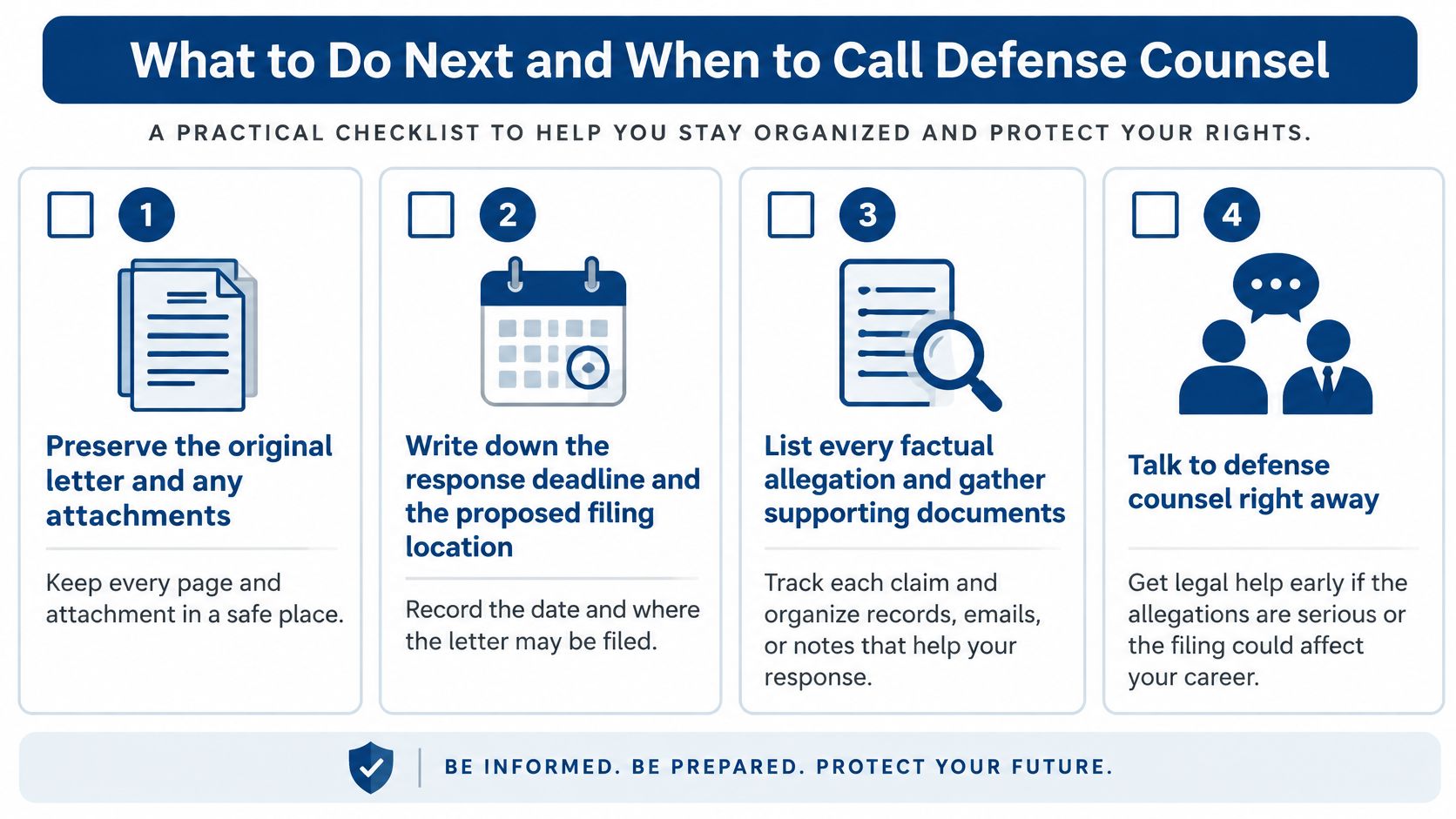
Early organization helps counsel evaluate the matter without spending the available response period reconstructing the packet. A practical checklist begins with the documents already in hand.
- Preserve the complete packet: Keep the original letter, attachments, and receipt information together.
- Record the deadline and proposed filing: A calendar reminder helps prevent the response date from being overlooked.
- Sort the allegations: Mark each factual claim as accurate, inaccurate, or unclear, then identify supporting records.
- Choose a requested outcome: Withdrawal, local filing, or another authorized disposition should be discussed in light of the facts.
- Keep submission records: Save the final response and evidence showing when and how it was delivered.
The checklist below provides a visual reminder of the immediate priorities.
When is legal help especially useful?
Defense counsel is worth contacting promptly when permanent filing is proposed, serious allegations are involved, or another action is pending. A close deadline and uncertainty about what to admit or dispute are also reasons to seek help early.
A base legal office can direct a service member to available military defense counsel. A civilian military defense lawyer may be hired instead of, or alongside, available military counsel.
State and base directory pages offer another way to locate civilian lawyers and official defense contacts. Before hiring, the service member should check the lawyer's license or bar status through the relevant state bar and ask about reprimand experience, fees, scope of representation, and availability before the deadline.
Common Questions About Letters of Reprimand
Is a letter of reprimand a conviction?
No. An administrative reprimand isn't itself a court-martial conviction or nonjudicial punishment. Separate proceedings may still accompany it.
Can a service member respond to a reprimand?
Yes. The Army process described here provides an opportunity for a written response before the filing decision. The notice supplies the case-specific submission instructions.
Does every reprimand stay on the record forever?
No. Local filing is generally temporary, while permanent AMHRR filing is different. Restricted access also shouldn't be confused with automatic expiration.
Is a lawyer necessary?
Not every situation requires hiring civilian counsel. A defense lawyer can help assess disputed facts, possible admissions, and filing consequences, especially when permanent filing or other action is possible.
The site's military law questions and answers offers additional plain-English explanations of related military legal issues.
The UCMJ Military Defense Lawyer Directory offers state and base searches for civilian military defense lawyers, with alphabetical rather than ranked listings and official defense counsel contacts where available. Service members facing a reprimand can visit the directory, contact prospective counsel about the response deadline, and compare representation options. This article is general information, not legal advice. Laws vary by state and change over time. Talk to a licensed attorney about your situation.