What does the specification say, word for word? People facing an Article 120 allegation start with the wrong question, which is whether the accusation is true. The first question is which theory of liability the government has charged, because Article 120 isn't one offense with one set of elements. Understanding Article 120 UCMJ allegations and defenses starts with reading the charge sheet line by line and matching each specification to the exact facts the government has to prove.
Table of Contents
- What Article 120 Covers and What Prosecutors Must Prove
- How an Allegation Moves From Report to Trial
- Defenses That Target the Charge, the Proof, or the Process
- How Evidence and Credibility Get Tested in Practice
- Court-Martial and Administrative Consequences Beyond the Verdict
- Choosing Free Military or Civilian Defense Counsel
- What to Do Next If You Face an Allegation
- Common Questions About Article 120 Defenses
What Article 120 Covers and What Prosecutors Must Prove
Which part of Article 120 does the specification charge? That question matters because Article 120 of the Uniform Code of Military Justice, codified at 10 U.S.C. § 920, covers several distinct theories of sexual offenses rather than one general charge. The current statutory text separates them by the circumstance alleged and by what the accused knew. This guide deals with process and proof only. It doesn't describe conduct.
The charge sheet works like a map. The article number, the wording of each specification and the dates alleged tell the reader which theory is in play, and the version of Article 120 in force on the date of the alleged conduct sets the elements. A person reading the charge should not guess from the label alone. The facts written into the specification narrow the issue, because each theory asks the government to prove a different set of elements.
Why the date on the specification matters
Congress rewrote the statute more than once. The 2012 edition of the UCMJ reflects substantial 2006 amendments and a later framework enacted in Public Law 112-81, effective 180 days after December 31, 2011, applying to offenses committed on or after that date. The published text of Article 120 shows why wording cannot be treated as interchangeable. An older allegation can't be read under today's wording.
That date issue is easy to miss because a charge sheet may use a short description that sounds familiar. The legal test still turns on the statute in force when the conduct is said to have happened. The date on the specification gives the reader the first clue, then the charged wording identifies which proof belongs to that theory.
Article 120 theories of liability and the proof each requires
The statute lists multiple separate methods, and the government must prove the method charged. Match the specification to one row below. Each row gives three things: the theory, the proof the government carries, and the part of that proof the defense can test. That structure helps avoid a common confusion. A defense to one theory may do little against another, because the elements change.
| Theory alleged | What the government must prove | What the defense tests |
|---|---|---|
| Sexual act by unlawful force | A sexual act committed by unlawful force | Whether the evidence shows force, and how force is defined in the version in force |
| Sexual act by force causing or likely to cause death or grievous bodily harm | A sexual act plus force of that severity | Whether injuries, records or accounts support that level of force |
| Sexual act by threat or fear of death, grievous bodily harm or kidnapping | A sexual act obtained by placing the person in fear of that harm | Whether a threat was made and whether the person actually feared it |
| Sexual act after the accused rendered the person unconscious | First rendering the person unconscious, then a sexual act | What medical records and the timeline show about consciousness |
| Sexual act after administering a drug, intoxicant or similar substance | Administering a substance that substantially impairs the ability to appraise or control conduct | What proof ties the accused to the substance and to the impairment |
| Sexual act without consent | A sexual act and knowledge or reason to know there was no consent | What the record shows about the accused's knowledge at the time |
| Sexual act with a person asleep, unconscious or otherwise unaware | That condition plus knowledge or reason to know of it | Whether there's any proof the accused knew of the condition |
| Sexual act with a person incapable of consenting | Incapacity from an intoxicant, drug, mental disease or defect, or physical disability, plus knowledge or reason to know | Whether the evidence separates incapacity from the sexual act itself |
| Fraud or impersonation | A fraudulent representation that the act served a professional purpose, or inducing a belief that the accused was someone else | What was represented or concealed, and what the person relied on |
Use the table as a proof checklist, not as a guess about what the government likely believes. If the specification alleges force, look at the force row. If it alleges lack of consent, look at the consent row and the knowledge language. If it alleges incapacity, separate the claimed condition from the accused's knowledge or reason to know. That step matters because the government must connect the accused to the legally required state of mind, not just describe what happened to the other person.
The accused is presumed innocent, and the government must prove every required element beyond a reasonable doubt. Write down the article, the specification and the date, then find the matching row.
How an Allegation Moves From Report to Trial
A case travels through set stages, and each one produces a record that later stages rely on. The path shifts by branch, by command and by which agency investigates, whether that's CID for the Army, NCIS for the Navy and Marine Corps, OSI for the Air Force and Space Force, or CGIS for the Coast Guard. Some cases end long before trial.
| Stage | What happens | Who decides or acts | Defense action |
|---|---|---|---|
| Report and investigation | Agency or command gathers statements, records and witness accounts | Investigators such as CID, NCIS, OSI or CGIS, or a command-directed inquiry | Invoke rights, request counsel, and avoid unrepresented interviews |
| Preferral | A commander or other authorized person swears to charges on a charge sheet | The person preferring charges; the convening authority decides later whether to refer | Check the article, specification wording and dates against the facts |
| Referral and arraignment | Case is sent to a court-martial and the accused is asked to plead | Convening authority refers; military judge presides | Enter pleas with counsel's advice and confirm the charges and forum |
| Motions | Challenges to the charges, evidence or procedures are argued | Military judge | File motions to dismiss charges or suppress evidence where grounds exist |
| Trial on the merits | Evidence is presented and guilt or innocence is decided | Panel members or military judge | Government must prove each element beyond a reasonable doubt |
| Sentencing | If guilty, punishment is set within Manual for Courts-Martial limits | Panel or military judge | Present mitigation and character evidence |
Preferral, referral and the Article 32 hearing
Preferral is the moment someone authorized swears to charges. Referral is the separate decision that sends those charges to a court-martial, and the two aren't the same event. Before referral in a general court-martial case, an Article 32 preliminary hearing puts the evidence in front of an investigating officer, who reviews it and recommends what should happen next. Defense counsel can question witnesses there, which makes it an early chance to test the file rather than a formality. The UCMJ military law guide walks through how these steps connect.
A report isn't a finding
The Defense Department's FY2025 annual report appendix on sexual assault lists 7,998 reports involving service members as victims or subjects and describes them as raw, uninvestigated reports, not conclusions that an offense occurred. A report, a charge and a finding of guilt are three different things.
Practical rule: counsel should be involved before the first interview, not after referral, because early statements become the record every later stage reads.
An administrative action can run on its own track at the same time, which is why one decision doesn't close the whole matter.
Defenses That Target the Charge, the Proof, or the Process
Defenses aren't a single list of arguments. They're aimed at four targets: the charge, the proof, the evidence and the process. The table sorts them by what each one attacks and when it gets raised.
| Defense target | What it challenges | Evidence to examine | When it is raised |
|---|---|---|---|
| Charge wording | Whether the specification names the right article, theory and dates | Charge sheet, dates, statute version in force | Usually raised by motion before pleas |
| Elements of proof | Whether the government can prove each required fact | Timelines, messages, witness accounts, records | Raised at trial through cross-examination and closing argument |
| Mental state | Whether the required knowledge or intent can be shown | Context, communications and conduct before and after the events | Argued at trial and in instructions to the panel |
| Evidence admissibility | Whether statements, searches or records were obtained and handled lawfully | Interview records, rights advisements, search authority, chain of custody | Pretrial motions to suppress or exclude |
| Investigation quality | Gaps, missed witnesses or contradictions in the inquiry | Investigative file, witness lists, unexamined leads | Pretrial motions and trial cross-examination |
| Process rights | Whether required notices, hearings and timelines were followed | Notices, hearing records, dates of each step | Pretrial motions or objections at the stage concerned |
No defense is guaranteed. Each one's strength depends on the record, and counsel decides which fit the facts.
Attacking the charge and the elements
A charge-wording attack asks whether the specification names the right theory and the right dates, and whether the statute version in force then supplies the elements alleged. An element attack is narrower: several theories require proof that the accused knew or reasonably should have known of a condition, so the defense separates proof of the act from proof of that knowledge.
Attacking the evidence and the process
Evidence attacks ask whether rights were explained before an interview, whether a search had authority, and whether records were handled properly. Investigation-quality attacks look for missed witnesses, unexplored leads and contradictions in the file. Process attacks cover missed notices and deadlines. The government has to prove the theory it chose, not a general claim of misconduct.
How Evidence and Credibility Get Tested in Practice
Consider a hypothetical, not a real case. A service member attends an off-base gathering and later gives an account of the evening that conflicts with a witness's account. The investigative file holds phone location data, message timestamps, a card receipt and statements taken weeks apart.
Counsel sorts that material into three piles: what supports the timeline, what contradicts it, and what's missing. A receipt places someone at a location at a time. Location data may confirm or undercut a stated departure time. Neither answers the legal question by itself.
Credibility gets tested on ordinary grounds:
- Consistency: does the account stay the same across statements, or shift on the disputed point?
- Corroboration: do records back up the account, or only repeat it?
- Timing: how close to the events was each statement taken?
- Follow-up: did investigators chase the leads that could confirm or contradict the account?
The same text message can help one side and hurt the other, which is why counsel reads the whole thread instead of one screenshot.
Deciding whether a witness is believable belongs to the panel members or the military judge. Counsel's job is to test the evidence. Keep a private timeline written close to the events, and don't create new documents to share with anyone without counsel's advice.
Court-Martial and Administrative Consequences Beyond the Verdict
A court-martial is one forum among several, and the result in one doesn't decide the others. There are three levels. A summary court-martial handles minor offenses with a simplified process. A special court-martial is the intermediate level. A general court-martial is the highest trial level, and Article 120 charges are usually tried there because of the maximum punishment available.
Findings come first, guilty or not guilty. Sentencing follows only if there's a finding of guilty, and it can include confinement, reduction in grade, forfeiture of pay and a punitive discharge. Exact maximum punishments come from the Manual for Courts-Martial, so check the current edition on official government sites rather than relying on a summary. The exposure range depends on the theory charged and the version of the statute in force on the date of conduct, which means the specification sets the range, not the offense label alone.
Administrative tracks run separately:
- Separation board or administrative separation: usually applies a different standard of proof, so the board can reach a different result than a trial.
- Reprimands and adverse actions: a letter of reprimand or similar action can follow a case even without a conviction.
Branch names and procedures differ across the Army, Navy, Marine Corps, Air Force, Space Force, Coast Guard, National Guard and Reserve. Ask counsel about every track at once, because a decision in one can affect the others.
Choosing Free Military or Civilian Defense Counsel
Every service member is entitled to detailed military defense counsel at no cost. Each branch names its defense office differently: Trial Defense Service in the Army, Area Defense Counsel in the Air Force, and Defense Service Office in the Navy and Marine Corps. The Coast Guard, National Guard and Reserve may use different arrangements, so confirm with the installation legal office.
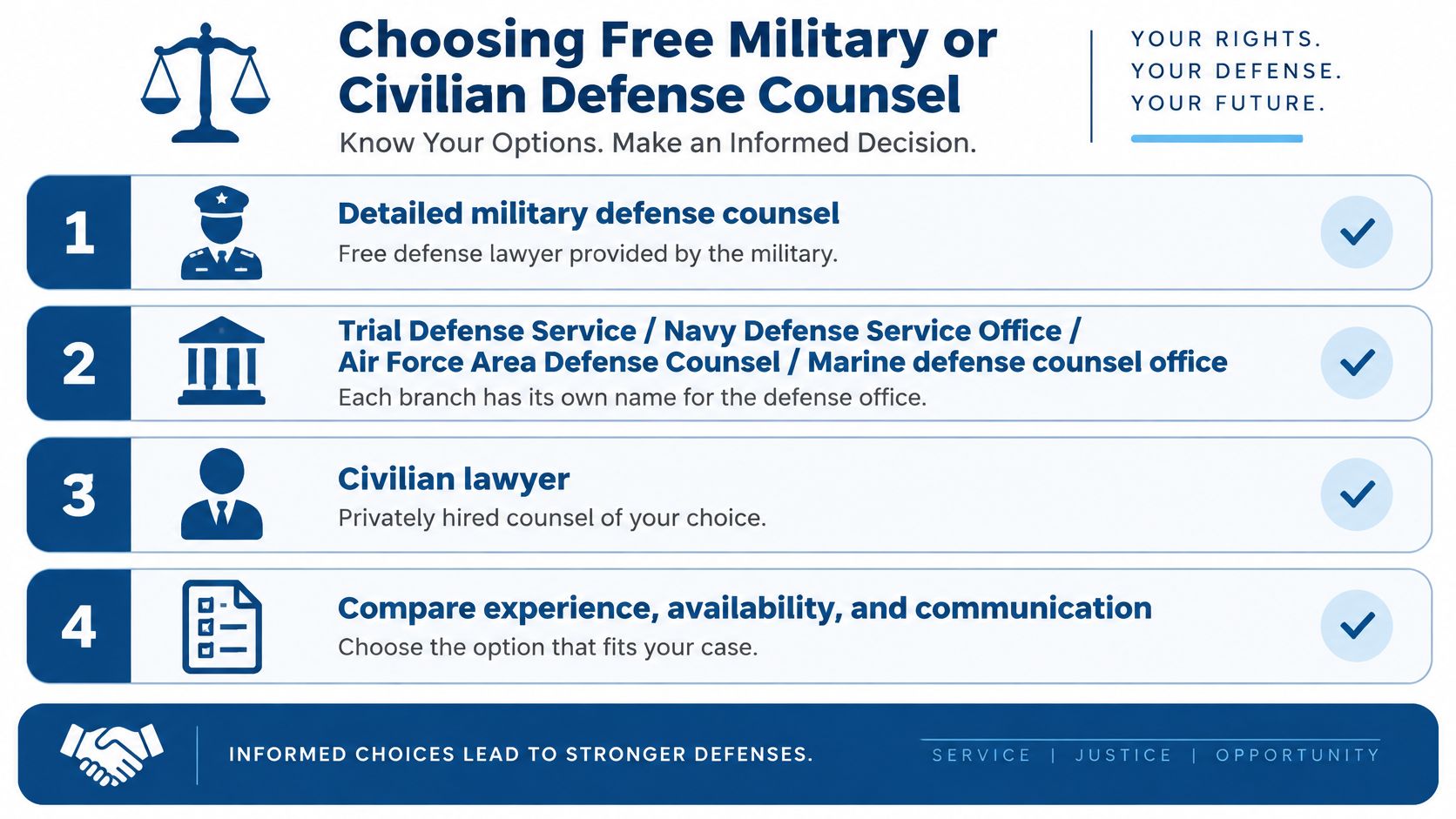
| Option | Cost to you | Who you work with | Best fit |
|---|---|---|---|
| Detailed military defense counsel | No cost to you | Military defense attorney assigned at your installation | Early advice and a free defense from the start |
| Civilian military defense lawyer | Paid; fees vary and should be in writing | Lawyer or firm you choose, licensed in a state you verify | Cases where you want a chosen attorney or long-term representation |
| Both together | Free counsel plus civilian fees | Two defense attorneys sharing the case | Complex cases where you want an added trial specialist |
Six questions to ask a civilian lawyer
- License: is it current and in good standing on the state bar website?
- Trial experience: how many court-martial trials have they handled?
- Who tries it: will that lawyer personally appear, or someone else?
- Fees: are they in writing, with what's included spelled out?
- Communication: how often will they update the client, and by what method?
- Conflicts: do they have any conflict with the command, witnesses or co-accused?
The UCMJ Military Defense Lawyer Directory lists civilian military defense lawyers by location in alphabetical order, not in rankings. No lawyer can guarantee results, and free counsel and a civilian lawyer can work on the same case together.
A short walkthrough of the representation decision:
What to Do Next If You Face an Allegation
The first days matter more than expected, because statements and deadlines both start running immediately.
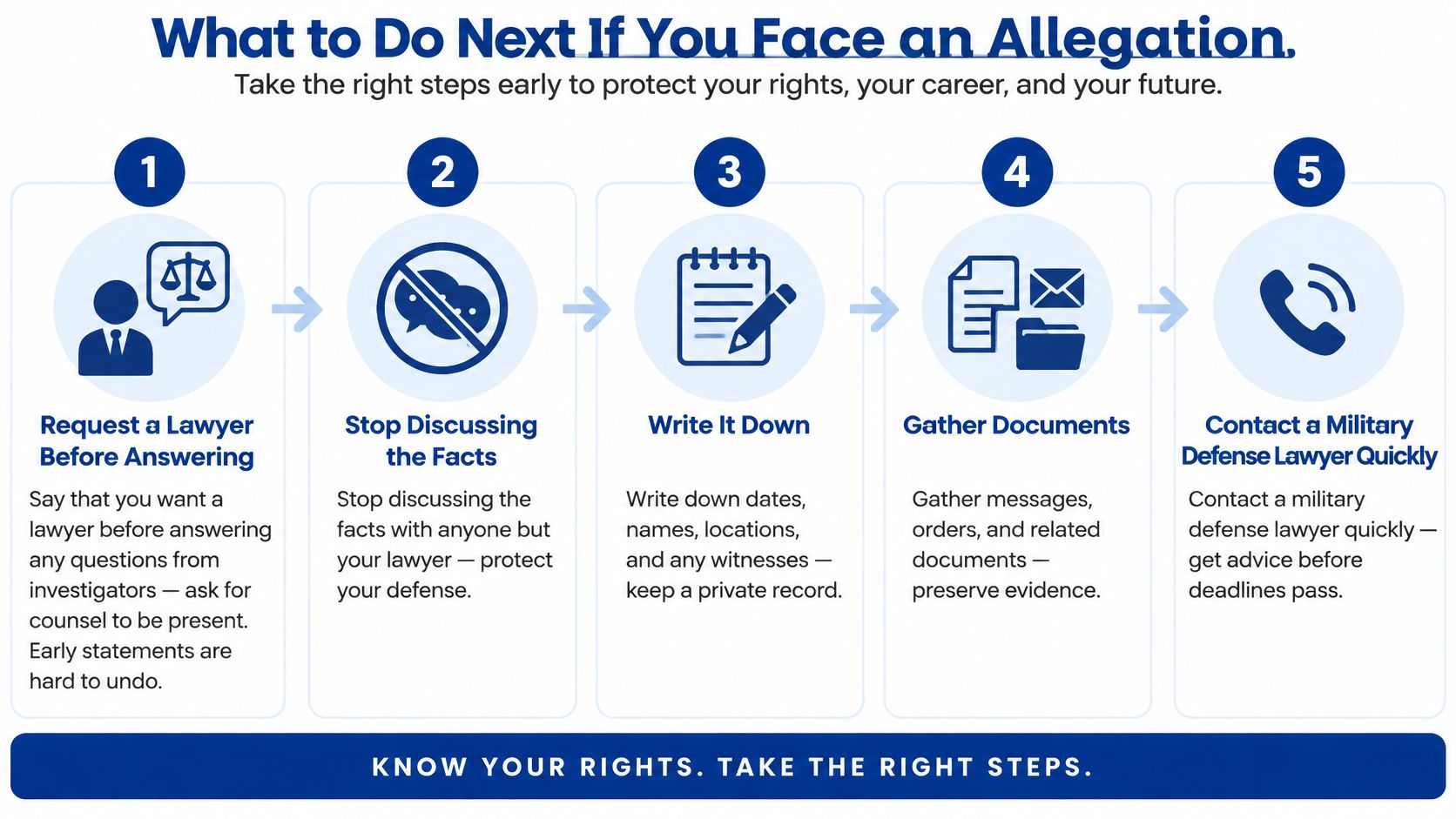
- Ask for a lawyer before answering questions. Tell investigators that counsel is requested and that counsel should be present, because an early statement can't be taken back.
- Get every notice, charge sheet and order in writing. Note the article, the specification wording and the dates alleged, since those set the elements in dispute.
- Contact detailed defense counsel right away, even if a civilian lawyer may be hired later. Free counsel can act now, and hiring later doesn't rewind the clock.
- Write a private timeline in plain words, dated and labeled as prepared for counsel. Memory fades, and a contemporaneous record helps counsel test the file.
- Preserve phones, messages, calendars, receipts and photos. Deleting anything can create a separate problem, so leave data intact and let counsel decide what to use.
- Follow no-contact and restriction orders exactly, including indirect contact through friends or social media. A violation becomes its own charge risk.
- Stop discussing the facts with other service members, online, or with anyone who might be a witness. Those conversations turn into testimony.
- Compare civilian lawyers using the six questions above, and ask for fees in writing before signing anything.
Response deadlines on notices run fast. Write each one down the day it arrives and give the date to counsel.
Common Questions About Article 120 Defenses
Is an allegation the same as a finding that an offense happened?
No. A report opens an investigation, and official military-justice reporting treats those reports as raw and uninvestigated. Only a charging decision, a plea or a finding of guilt changes a person's legal status.
Which version of Article 120 applies?
The law in force on the date of the alleged conduct, which is why the date on the specification matters so much given the 2006 amendments and the 2012 framework in Public Law 112-81.
Can the same conduct be charged under a different article?
Sometimes. Article 120 has to be kept separate from neighboring offenses such as Article 120a, and the classification changes what the government must prove. Readers comparing offenses can browse the military law answers library for related explanations.
How long does a case take?
It depends on the evidence, the motions filed and court scheduling. Counsel can give a realistic estimate for the specific situation.
This article is general information, not legal advice. Laws vary by state and change over time. Talk to a licensed attorney about your situation.
The UCMJ Military Defense Lawyer Directory lists civilian military defense lawyers by state, base and overseas location in alphabetical order, alongside the free defense counsel office at each installation, so a service member reading a specification can find someone who tries these cases. Searching costs nothing, and listings aren't rankings. Visit the UCMJ Military Defense Lawyer Directory to find counsel near the installation handling the case and get advice before the next deadline passes.